
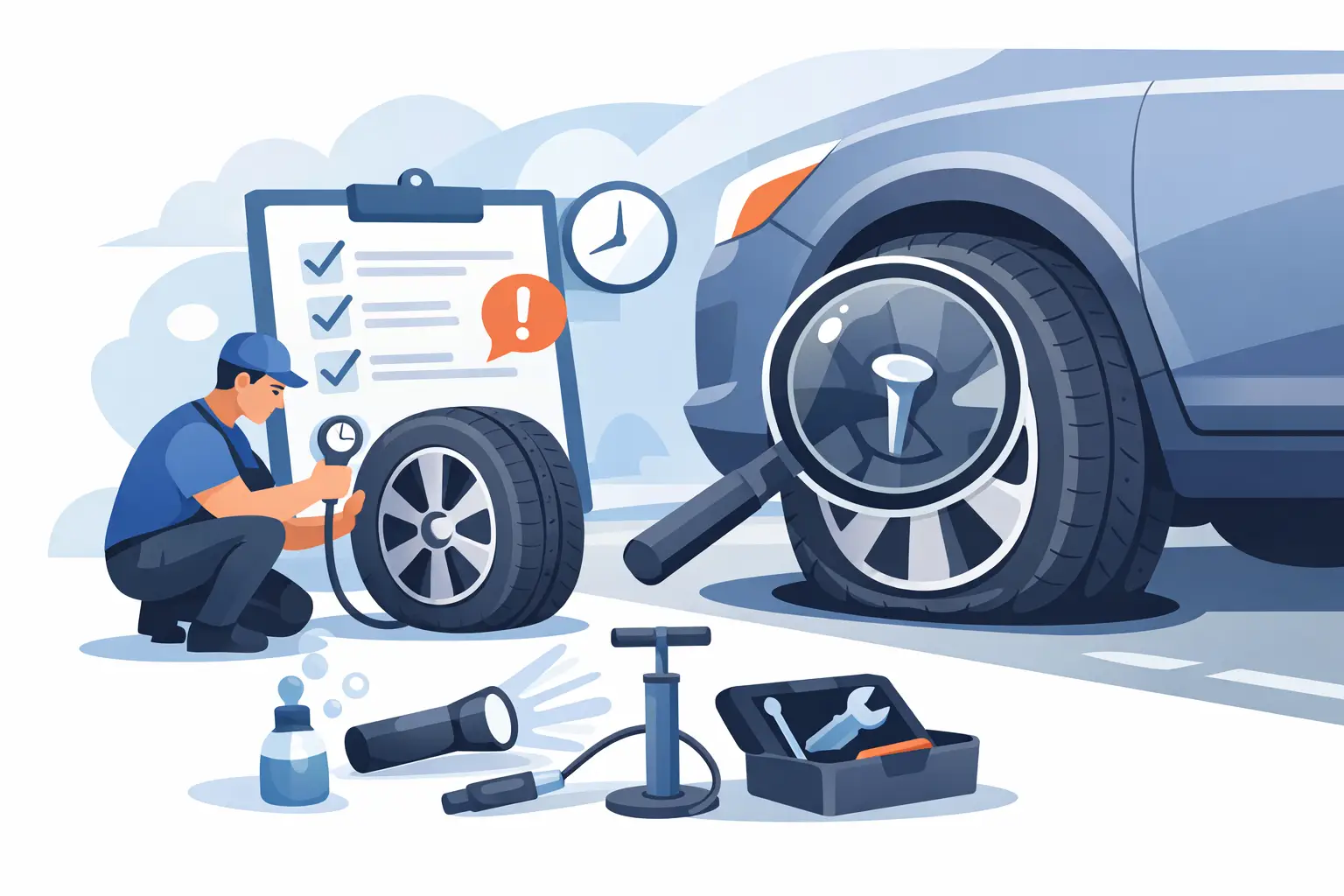
Slow puncture diagnosis steps that actually work
You usually notice a slow puncture at the worst possible time – on the school run, before work, or when the car has been sitting overnight and one tire looks lower than the rest. The right slow puncture diagnosis steps can save you time, prevent sidewall damage, and help you decide whether the tire needs a simple repair or a full replacement.
A slow puncture is different from a blowout or sudden flat. Air escapes gradually, which makes the problem easy to ignore for a few days. That is where trouble starts. Driving too long on an underinflated tire can damage the casing, affect handling, increase wear, and in some cases make the tire unsafe to repair.
Why slow punctures are often missed
Most drivers do not inspect their tires closely unless a warning light comes on. Even then, it is tempting to add air and carry on. Sometimes that works for a day or two, but if the pressure keeps dropping, there is a leak somewhere.
The leak is not always caused by a nail in the tread. It could be a faulty valve, corrosion around the wheel rim, a small split, or even damage from hitting a pothole. That is why guessing is rarely the quickest route. A proper check narrows it down fast.
Slow puncture diagnosis steps before you do anything else
Start with safety. If the tire is visibly very low, if the sidewall looks pinched, or if the vehicle feels unstable, do not keep driving on it. A short trip on a nearly flat tire can turn a repairable issue into a replacement.
Park on level ground and look at the tire in daylight if possible. If you have driven recently, give it a moment to cool down before checking pressure. Tire pressure rises with heat, so a hot reading can mislead you.
Step 1: Confirm there is a pressure loss pattern
Use a reliable tire pressure gauge and compare the reading with the recommended pressure for your vehicle. If one tire is consistently lower than the others, you are not dealing with normal fluctuation.
It helps to top the tire up to the correct pressure and recheck it the next day. If it drops again, that confirms a slow leak rather than a one-off change caused by temperature. If the pressure falls quickly in a few hours, treat it as more urgent.
Step 2: Inspect the tread carefully
Look for anything embedded in the tire – screws, nails, sharp stones, bits of metal, or glass. Some punctures are obvious. Others are tiny and hide between tread blocks.
Do not pull an object out just to see what happens. If something is lodged in the tread, it may be slowing the leak by partially sealing the hole. Removing it can leave you with a flat tire on the spot.
Step 3: Check the sidewall and shoulder
Not every air loss comes from the center tread area. Examine the shoulder and sidewall for bulges, cuts, cracks, or scuffing. Damage here matters because sidewall punctures usually cannot be repaired safely.
This is one of those it depends situations. A small tread puncture in the repairable zone is often fixable. A split or impact damage in the sidewall usually means replacement is the safer option.
Slow puncture diagnosis steps for valves and rims
If the tread looks clean, move on to the wheel components. This is where many slow leaks are found, especially on older wheels or vehicles that have had curb contact.
Step 4: Test the valve for leaks
The valve stem is a common failure point. Dirt, age, cracked rubber, or a failing valve core can all let air escape slowly.
A simple test is to apply soapy water around the valve opening and the valve stem. If bubbles form, the valve is leaking. Sometimes the fix is straightforward, such as replacing the valve core or the stem. Sometimes the issue is more stubborn if the valve seat itself is damaged.
Also check that the valve cap is present. It is not the main seal, but it does help keep dirt and moisture out, and that can prevent valve problems over time.
Step 5: Check the bead area and rim edge
The bead is where the tire seals against the rim. If there is corrosion, dirt, or slight wheel damage in that area, air can seep out slowly.
Spray soapy water around the rim edge where the tire meets the wheel. Watch for a line of small bubbles. On alloy wheels especially, corrosion can build up gradually and break the seal. This is common enough that a tire can look fine from the outside but still lose pressure every few days.
If the rim is bent from a pothole strike, the leak may not be obvious without removing the wheel and inspecting it closely. In that case, a mobile tire technician or shop can usually pinpoint it quickly.
What soapy water can and cannot tell you
A soap-and-water test is one of the easiest ways to find a slow leak, and it often works well. Spray or wipe the solution over the tread, sidewall, valve, and bead area, then look for bubbling.
But it is not perfect. Very small leaks can be hard to spot, and some punctures only open up when the tire is under load. If you cannot find the source but the pressure keeps dropping, that does not mean the problem has gone away. It usually means the leak needs a more thorough inspection.
When the problem is inside the tire
Sometimes the outside of the tire gives very little away. A puncturing object may have gone in and come back out. The hole can be tiny. There may also be internal damage from being driven underinflated.
That is why a proper repair decision should be based on an internal inspection, not just what is visible from outside. A tire may look repairable in the driveway, but once removed from the wheel it can show wear dust, liner damage, or a puncture angle that makes repair unsafe.
When to stop driving and call for help
If you are losing pressure repeatedly, adding air is only a short-term measure. It can get you out of a tight spot, but it is not a fix. The more the tire runs low, the more likely you are to damage it.
Stop driving and arrange help if the tire goes soft again within a day, if you can see sidewall damage, if the steering feels off, or if the warning light keeps returning after inflation. If you are at home, at work, or stranded roadside, having someone come out is often the quickest option because the tire can be inspected where the car is sitting.
For drivers around Reading, Basingstoke, and Bracknell, that convenience matters. Lee’s Mobile Tyres handles these kinds of problems on site, which means you do not have to risk driving on a questionable tire just to get it looked at.
Repair or replace?
This is the part most drivers want answered straight away, but it depends on the location and condition of the damage. A puncture in the central tread area is often repairable if the hole is within safe limits and the tire has not been driven flat. A leak from a bad valve or corroded bead can also often be sorted without replacing the tire itself.
Replacement is more likely if the sidewall is damaged, the tire has structural wear from being run underinflated, the puncture is too large, or the tread is already close to the legal limit. There is no benefit in forcing a repair on a tire that will not be reliable afterward.
How to prevent the same issue happening again
Check your tire pressures regularly, not just when a dashboard light appears. A quick check every couple of weeks catches small problems early. It also helps your tires wear evenly and improves fuel economy.
Try to avoid mounting curbs, and be cautious around potholes where possible. Keep valve caps fitted and replace worn tires before they become vulnerable to repeated punctures. If one tire has been losing air more than once, have the wheel and valve inspected properly rather than topping it off again and again.
A slow puncture rarely fixes itself. The sooner you track down the cause, the easier it is to keep the repair simple, the cost reasonable, and your day moving the way it should.