
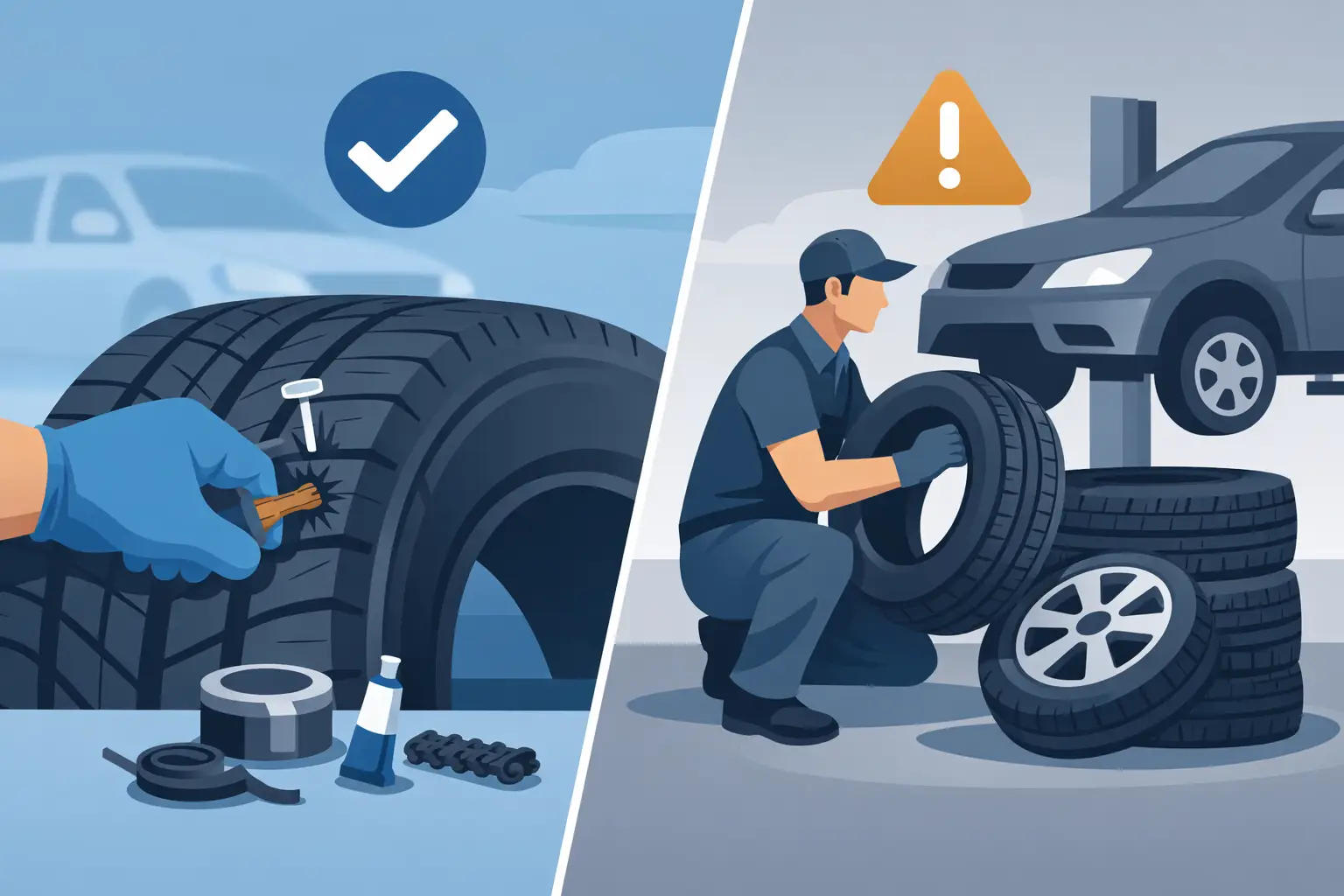
Puncture Repair vs Replacement: What’s Safer?
A flat tire at home before work is one thing. A warning light on the roadside with kids in the car is another. In both cases, puncture repair vs replacement comes down to one question: can the tire be made safe again, or is it time to fit a new one?
That decision is not just about saving money. It is about safety, reliability, and whether you want to deal with the same problem again next week. Most drivers are not looking for a lesson in tire construction. They just want a straight answer, quickly, and they want the job done without wasting half the day at a garage.
Puncture repair vs replacement: the basic rule
If the damage is small, in the repairable area, and the tire has enough healthy tread left, a repair is often the sensible option. If the damage is too large, too close to the sidewall, or the tire is already worn or structurally compromised, replacement is the safer call.
That sounds simple, but real-world tire damage rarely shows up in neat categories. A screw in the tread might look minor from the outside, yet the inside of the tire could tell a different story. On the other hand, a tire that looks finished at first glance may actually be a straightforward repair.
The key is proper inspection. A quick plug done without checking the inside is not the same as a professional repair. If you are choosing between repair and replacement, what matters is not just the hole. It is the condition of the whole tire.
When a puncture repair usually makes sense
A repair is usually possible when the puncture is in the central tread area, caused by something like a nail or screw, and the hole is relatively small. The tire also needs to have enough tread left to justify fixing it.
This is often the best-case scenario for drivers. You keep the original tire, spend less than you would on a replacement, and get back on the road quickly. For a busy commuter or a parent juggling school runs and work, that matters.
A proper repair is not about patching over the problem and hoping for the best. It should restore the tire safely and hold air reliably. When done correctly, a repair can offer a solid, practical result without forcing you to pay for a new tire before you need one.
There is also the question of value. If the tire is fairly new and in otherwise good shape, replacing it after one simple puncture can feel unnecessary. In those situations, repair is often the most sensible route.
When replacement is the better option
Some tires should not be repaired, even if the puncture looks small. Damage near or in the sidewall is a common example. The sidewall flexes constantly, and that makes repairs there unsafe.
Replacement is also the right choice if the tire has been driven while flat for any distance. This is more common than people realize. A driver notices the pressure is low, carries on to get home or reach a safer place, and the internal structure gets damaged in the process. From the outside, the tire may not look too bad. Inside, it may be finished.
Tread depth matters too. If the tire is already close to the legal minimum or clearly worn out, repairing it usually does not make financial sense. You would be paying to extend the life of a tire that does not have much life left.
Then there is multiple damage. If a tire has more than one puncture, previous poor repairs, cuts, bulges, or signs of aging, replacement is generally the cleaner and safer solution. At that point, the issue is not just one hole. It is overall tire integrity.
The factors that decide repair or replacement
Location of the puncture
This is one of the biggest factors. Punctures in the main tread area are often repairable. Punctures in the shoulder or sidewall usually are not.
That is why two tires with similar-looking nails can have completely different outcomes. Where the object went in matters as much as the size of the hole.
Size of the damage
Small punctures from nails or screws are often repairable. Larger holes, tears, or damage from sharp impacts usually push the tire into replacement territory.
If the tire hit a pothole hard enough to split the rubber or damage the cords, repair is not the answer.
How long it was driven on
A tire that loses pressure and is then driven on can suffer internal sidewall damage very quickly. This is one of the main reasons a simple puncture turns into a replacement job.
Even a short drive on a flat or nearly flat tire can be enough to rule out repair.
Tread depth and age
If the tire is already worn, repairing it may be false economy. You fix one issue today and end up replacing the tire soon after anyway.
Older tires can also be less worth saving, especially if there are signs of cracking or general deterioration.
The type of repair available
Not all repairs are equal. A proper professional repair is very different from a temporary roadside fix or a can of sealant. Temporary products may help you move the car in an emergency, but they are not the final answer.
If you want the tire to stay safe and dependable, the repair needs to be done the right way.
Cost: cheaper now vs better value later
For most drivers, price is part of the decision. That is fair. Repair is usually cheaper than replacement, and if the tire is suitable for repair, that lower cost can be the right choice.
But the cheapest option today is not always the best value over the next few months. If a tire is worn, damaged, or close to needing replacement anyway, fitting another tire may save you from paying twice.
This is where honest advice matters. A good tire service should not push a replacement if a repair is safe. Just as importantly, they should not sell a repair to avoid an awkward conversation when the tire really needs changing.
Convenience matters more than most drivers admit
A lot of people picture this decision happening in a shop with plenty of time to think. In reality, it often happens on a driveway before work, in an office parking lot, or on the roadside while your whole day falls behind.
That changes things. Fast inspection and on-the-spot service can be just as important as the technical decision itself. If the tire can be repaired safely where the vehicle is parked, that saves time, stress, and often the cost of towing or rearranging your day.
If it needs replacement, getting that done on site is just as valuable. For everyday drivers, convenience is not a luxury. It is the difference between losing an hour and losing a whole day.
That is why mobile service works well for situations like this. Companies like Lee’s Mobile Tyres are built around the reality that most people do not want to sit in a waiting room over a puncture if they do not have to.
How to make the right call fast
If you have picked up a puncture, the best move is usually not to guess. Avoid driving on it if possible. Check whether the tire is visibly damaged, losing air rapidly, or sitting flat on the rim.
From there, a proper inspection will tell you what you actually need. Sometimes that means a straightforward repair and you are back on the road quickly. Sometimes it means replacement because the damage, wear, or internal condition makes repair the wrong bet.
The important thing is to treat the decision as a safety call, not just a price comparison. A repair should only happen when the tire is genuinely fit to stay in service.
A common mistake: waiting too long
One of the biggest reasons drivers end up needing replacement is delay. A slow puncture gets ignored for a few days. Air pressure drops. The tire gets driven underinflated. What might have been repairable at first turns into a damaged tire that has to be replaced.
If your tire pressure warning light comes on, or you keep topping up the same tire, it is worth getting it checked sooner rather than later. Acting quickly often gives you more options.
A good tire service should make the decision simple. If it is safe to repair, they should say so. If it is not, they should explain why in plain English and get you moving again without any drama. When you are stuck with a flat, that is really what you need most: a clear answer, a fair price, and someone who can sort it there and then.