Why Tyres Lose Pressure Overnight and What to Do
A tire that looks fine when you park up but sits low or flat by morning is more than an annoyance. If you are wondering why tyres lose pressure overnight, the answer is usually a slow air leak, not bad luck. The key is finding the cause before a small repair turns into a damaged tire, wheel, or unsafe journey.
A properly inflated tire should not lose a noticeable amount of pressure overnight. Temperature can change the reading slightly, especially on a cold night, but it will not normally leave one corner of the vehicle looking flat. If it happens more than once, treat it as a fault that needs checking.
Why tyres lose pressure overnight
Air can escape from several places, and the leak is not always obvious from the outside. A nail or screw in the tread is common, particularly after driving through building sites, side roads, or areas with debris. The object may stay lodged in the tire and slow the leak down, which is why the tire can hold air for hours before dropping overnight.
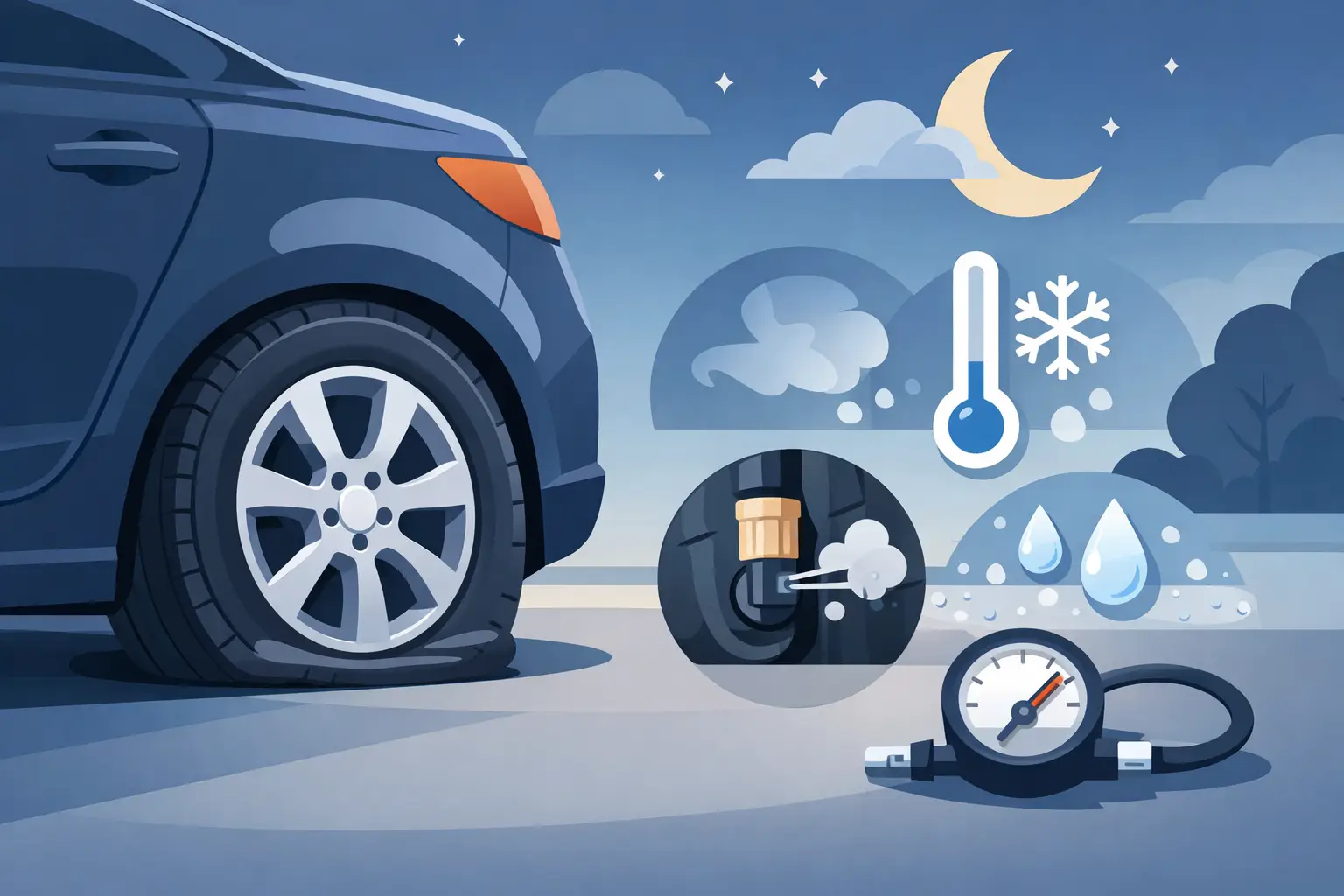
The valve is another frequent culprit. The valve core is the small part inside the valve stem that seals when you remove the cap. If it is loose, worn, or damaged, air can seep out slowly. A cracked rubber valve stem can do the same, especially as it ages.
Leaks can also develop where the tire meets the wheel rim. Dirt, corrosion, old tire sealant, or a slightly bent wheel can stop the bead from sealing properly. This is more likely with older wheels and after hitting a pothole or curb. The tire may look undamaged, but the air is escaping around its edge.
Less commonly, the wheel itself may be cracked. This can happen after a hard impact and is not always easy to spot without removing the wheel and inspecting it properly. A damaged tire sidewall can also leak, although sidewall damage often brings a more urgent safety concern.
Could cold weather be the reason?
Cold weather affects tire pressure. As air temperature falls, the pressure inside the tire falls too. A rough guide is that a tire can lose around 1 PSI for every 10 degrees Fahrenheit the temperature drops. So, if you checked your tires on a warm afternoon and the temperature falls sharply overnight, they may read lower in the morning.
That is normal, but there is a limit. Cold weather should cause a small pressure drop across all four tires, not leave one tire visibly soft or flat. If one tire consistently loses much more than the others, there is almost certainly a leak to investigate.
Always check pressure when the tires are cold, ideally before driving or after the vehicle has been parked for several hours. Use the pressure listed on the vehicle placard, usually found inside the driver-side door frame or in the owner’s manual. Do not use the maximum pressure stamped on the tire sidewall as your everyday target.
How to tell whether you have a slow puncture
A slow puncture is not always dramatic. You may notice the tire pressure warning light appearing every few days, a tire that needs topping up repeatedly, or one side of the vehicle looking slightly lower when parked. The steering can feel heavier, the vehicle may pull to one side, and fuel use can rise because an underinflated tire creates more rolling resistance.
Look closely at the tread for screws, nails, sharp stones, or cuts. Do not pull out a nail or screw if you find one. It may be helping the tire retain what little air is left. Instead, check the pressure, add air if needed, and arrange for the tire to be inspected.
You can also listen near the tire for a faint hiss and inspect the valve cap and stem. However, not seeing a problem does not prove the tire is safe. Many leaks are too small to find without a proper pressure test, soapy-water check, or removal of the wheel.
A note on tire sealant
Emergency tire sealant can sometimes get you moving, but it is not a cure for every puncture. It may not work on sidewall damage, large holes, a damaged rim, or a tire that has been driven flat. It can also make later repairs messier. If you use sealant, tell the technician before the tire is inspected.
Do not keep driving on a low tire
It is tempting to inflate the tire and carry on, especially when you have work, school runs, or appointments to manage. But a tire that loses pressure overnight can quickly become unsafe. Driving with low pressure causes the sidewalls to flex excessively, creating heat and internal damage that may not be visible from the outside.
Once a tire has been driven very low or flat, a straightforward puncture repair may no longer be suitable. The tire could need replacing even if the original hole is small. Continuing to drive also risks damaging the wheel rim, which adds unnecessary cost.
If the tire is completely flat, avoid driving on it unless there is no safer option to move out of immediate danger. Use your spare if you have one and know it is safe to fit, or arrange roadside assistance. If the tire is low but not flat, inflate it only enough to move the vehicle safely for inspection, while keeping a close eye on the pressure.
When a puncture can be repaired
A repair depends on where the damage is, how large it is, and whether the tire has been run underinflated. Small punctures in the central tread area can often be repaired safely if the tire is otherwise in good condition. Punctures near the shoulder or sidewall usually cannot be repaired because those areas flex more while driving.
The tire also needs enough remaining tread and no internal damage. A proper repair involves inspecting the tire from the inside, not simply plugging the hole from the outside. That inspection matters because it confirms whether the tire is still safe to return to service.
If replacement is needed, the right choice depends on the vehicle, the condition of the other tires, and your budget. A tested part-worn tire can be a practical option in some situations, while a new tire may make more sense for long-term use, matching an axle pair, or higher-mileage driving.
What to do when you wake up to a flat tire
First, do not assume it will hold air long enough for a normal drive. Check for visible damage, inflate the tire if you can do so safely, and see whether pressure drops again. If it does, or if the tire has no pressure at all, the vehicle should be inspected where it is.
For drivers around Reading, Basingstoke, Bracknell, and nearby areas, Lee’s Mobile Tyres can come to your home, workplace, or roadside location for puncture assessment, replacement, and fitting. That saves you from trying to drive a questionable tire to a garage or arranging transport while your vehicle is off the road.
Preventing repeat pressure loss
Checking tire pressures monthly is one of the simplest ways to catch a problem early. Include the spare if your vehicle has one. Check after a big temperature change, before a long trip, and after hitting a pothole or curb hard enough to make you wince.
Keep valve caps fitted, avoid parking against curbs, and do not ignore a tire pressure warning light just because it goes away after you add air. Repeated pressure loss is the warning, not the solution.
A low tire in the morning can disrupt the day, but it does not have to become a bigger problem. Get it checked before your next journey, and you will have a clearer answer than another quick top-up and a hope that it holds.