How to Test Wheel Alignment Before It Wears Tires
A car that constantly needs a small correction to stay straight can make even a short commute tiring. More importantly, it can wear out a good set of tires far sooner than expected. Knowing how to test wheel alignment gives you a quick way to spot a problem before uneven tire wear, poor handling, or a roadside tire issue turns into a bigger expense.
You do not need a workshop full of equipment to notice the warning signs. A professional alignment machine is the only reliable way to measure and adjust the angles precisely, but a few simple checks can tell you whether it is time to book an inspection.
What Wheel Alignment Actually Means
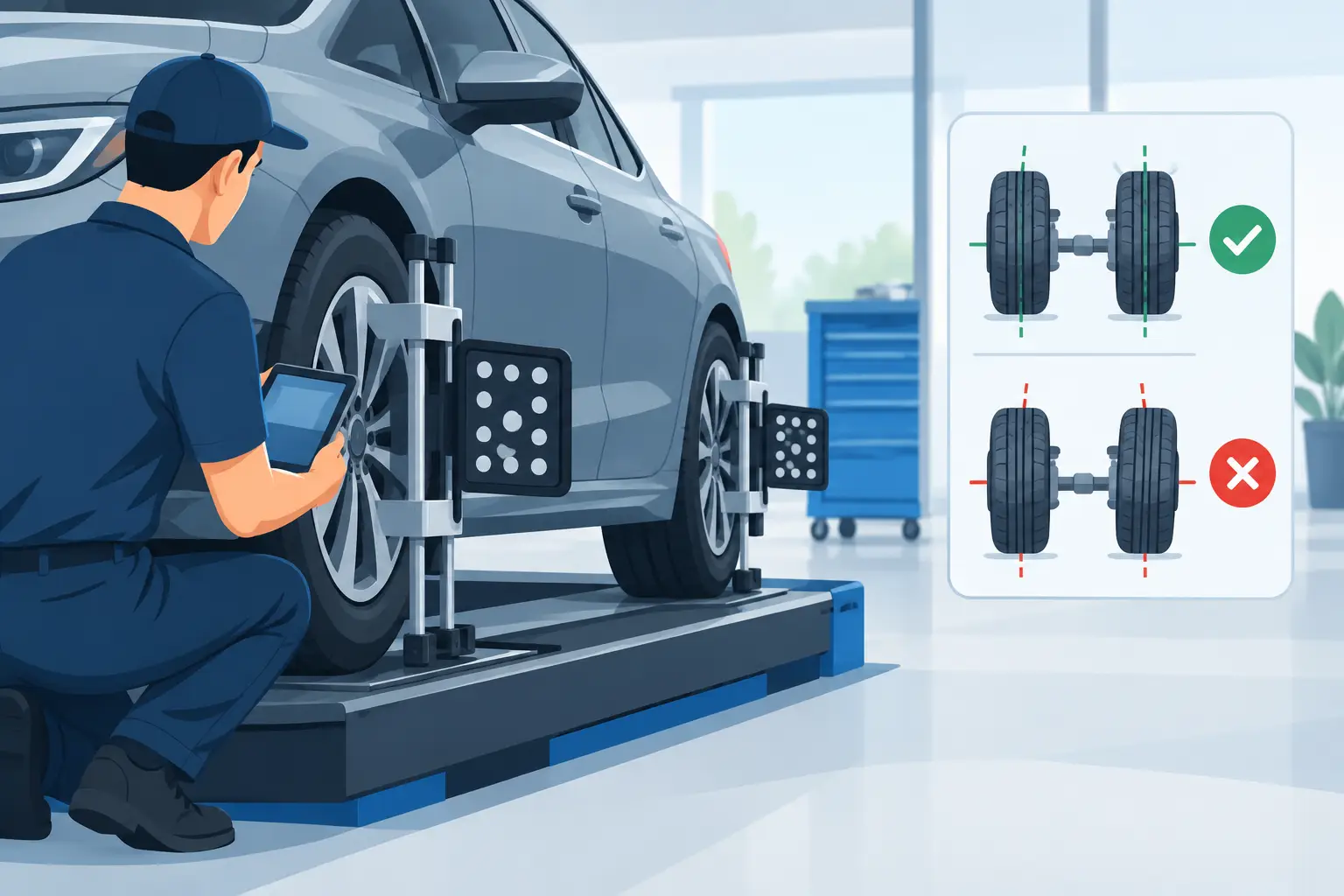
Wheel alignment is the adjustment of the angles at which your wheels sit and travel. The main settings are toe, camber, and caster. Toe describes whether the tires point slightly inward or outward when viewed from above. Camber is the inward or outward tilt of the wheel when viewed from the front. Caster affects steering stability and how the steering wheel returns after a turn.
When these settings are within the vehicle manufacturer’s specification, the car should track straight, steer predictably, and spread tire wear evenly across the tread. A pothole, curb strike, worn suspension part, or even repeated driving on rough roads can knock those angles out of place.
Alignment is not the same as wheel balancing. Balancing corrects a vibration caused by uneven weight around a wheel and tire assembly. Alignment corrects the direction and angle at which the wheels roll. Both matter, but one does not fix the other.
How to Test Wheel Alignment on a Safe, Flat Road
The most useful at-home check is a controlled road test. Choose a quiet, straight, level stretch of road with little traffic. Avoid testing on a road that slopes sharply toward the curb, as many roads have a slight crown for drainage and this can make a vehicle drift a little to one side.
First, check your tire pressures when the tires are cold. Uneven pressure can cause a pull and make an alignment issue harder to judge. Inflate all tires to the pressure shown on the vehicle placard, usually found inside the driver’s door frame or in the owner’s manual.
Drive at a steady speed with a light grip on the steering wheel. On a clear road, briefly relax your grip without taking your hands far from the wheel. The vehicle should continue mostly straight. A gentle drift can be normal depending on the road surface, but a firm pull that requires regular correction is worth investigating.
Repeat the test in the opposite direction on another similarly flat road if possible. If the pull consistently remains toward the same side, it is more likely to be the car than the road. If it changes with the road, the surface may be the cause.
Do not let go of the wheel completely or test on busy roads. The point is to observe the car, not create a hazard.
Check the Steering Wheel Position
While driving straight on a level road, look at the steering wheel. It should sit close to centered. If you have to hold it noticeably left or right to travel straight, the alignment may be off.
A crooked steering wheel does not always mean the vehicle pulls. Sometimes the wheels are generally pointing in the right direction, but the steering wheel was not centered during a previous alignment. It is still worth having checked because a properly centered wheel makes the vehicle easier and safer to control.
Pay Attention Under Braking
On a safe, empty stretch of road, apply the brakes smoothly from a moderate speed. If the car sharply pulls to one side only when braking, the cause may be a sticking brake caliper, uneven brake pads, or another brake fault rather than wheel alignment.
That distinction matters. Do not assume every pull is an alignment issue, especially if it appears suddenly or only under braking. Brake problems should be inspected promptly.
Inspect Your Tire Wear Closely
Your tires often tell the clearest story. Turn the steering wheel fully so you can see the front tire tread, then inspect both inside and outside edges. Run your palm lightly across the tread blocks in both directions, feeling for changes in texture.
Look for these patterns:
- Wear mainly on the inner or outer edge can point to excessive camber, worn suspension parts, or incorrect tire pressure.
- Feathering feels smooth in one direction and sharp in the other. It often suggests a toe setting problem.
- Cupping or scalloped dips around the tread can be caused by worn shocks, struts, loose suspension components, or wheel balance issues.
- One tire wearing much faster than the tire on the other side can indicate alignment trouble, but it can also come from a damaged tire or mechanical issue.
Check all four tires if you can. Rear-wheel alignment problems are easy to miss because the steering may feel normal, yet the rear tires can still wear unevenly or cause the vehicle to track at an angle.
If cords are showing, the tread is badly uneven, or the tire has a bulge or cut, do not wait for an alignment appointment. The tire may need immediate replacement.
Look at the Vehicle From the Front and Rear
Park on level ground and stand several feet in front of the vehicle. Look at the wheels rather than the bodywork. One wheel that appears to lean noticeably inward or outward compared with the other may indicate a camber problem, damaged suspension, or a bent component.
You can repeat this from behind the vehicle. This is only a visual screening check, not a measurement. Small differences are hard to see by eye, and many modern vehicles have alignment angles that are not obvious without proper equipment.
Avoid trying to adjust tie rods, suspension bolts, or other steering parts yourself based on a driveway observation. An incorrect adjustment can make handling worse, wear tires quickly, and leave the steering wheel off center.
Other Signs Your Alignment May Be Off
A road test and tire inspection are the best starting points, but several everyday clues can support what you find. The steering may feel loose, reluctant to return after a turn, or unusually nervous on the highway. You may also hear tire noise that was not there before, especially a humming sound caused by uneven tread wear.
Think about what happened before the issue began. A hard pothole impact, clipping a curb while parking, hitting road debris, or replacing steering or suspension parts are all good reasons to have the alignment checked. Even a low-speed impact can move a component enough to affect tire wear.
If the vehicle has recently had new tires fitted, check its alignment soon if there were existing signs of uneven wear. New tires will not correct the underlying angle problem. They can simply become the next expensive set to wear out early.
When a Professional Alignment Check Is Needed
At-home checks are useful for deciding whether something is wrong. They cannot confirm the exact setting or identify every cause. A proper alignment inspection uses calibrated equipment to compare each wheel angle with the manufacturer’s specification.
Book a professional check if your vehicle consistently pulls, the steering wheel is off center, you see uneven tread wear, or you have hit a pothole or curb hard enough to make you question the suspension. Also arrange an inspection after replacing tie rods, control arms, ball joints, struts, or other steering and suspension parts.
A good technician should inspect the tires and suspension before making adjustments. Alignment cannot fix a worn ball joint, bent wheel, damaged tire, seized adjuster, or weak suspension component. In some cases, repairing the mechanical fault comes first, followed by alignment once the vehicle is safe to adjust.
For drivers around Reading, Basingstoke, Bracknell, and nearby areas, Lee’s Mobile Tyres can help with tire concerns and practical alignment support without adding another unnecessary trip to your day. If uneven wear has already damaged a tire, getting it assessed early can prevent a simple handling problem from becoming a sudden flat.
Protect Your Tires Between Checks
Alignment does not need to be a constant worry, but regular attention saves money. Check tire pressures monthly, inspect tread when you wash the car, and avoid potholes where it is safe to do so. Rotate tires according to the vehicle manufacturer’s recommendation, particularly if the front tires do most of the steering and braking work.
If your car starts asking for more steering input than usual, trust that change. A quick check now is far easier than discovering worn-out tire edges on the morning you need to be somewhere.