Roadside Tyre Fitting Service: What to Expect
A flat tire rarely happens when you have time to spare. It happens before work, on the school run, outside a job, or late at night when most garages are shut. That is exactly when a roadside tyre fitting service matters most. Instead of waiting for a tow or trying to limp to a shop on a damaged tire, you can have the right help come to you and get the vehicle safely moving again.
For most drivers, the main question is simple: how quickly can this be sorted, and what happens next? If you have never used a mobile tire fitter at the roadside before, the process is usually much more straightforward than people expect.
How a roadside tyre fitting service works
The first step is the call. You explain where you are, what vehicle you drive, and what has happened. In some cases, the issue is clearly a puncture. In others, the tire may be split, blown out, or too damaged to repair. A good mobile fitter will ask the right questions up front so they can arrive with the correct tire size and the equipment needed to do the job safely.
Once on site, the fitter checks the condition of the tire, the wheel, and the surrounding area. If the damage is minor and repairable, a puncture repair may be enough. If the tire is unsafe, a replacement is the better option. That decision should never be rushed, because the cheapest fix is not always the safe one.
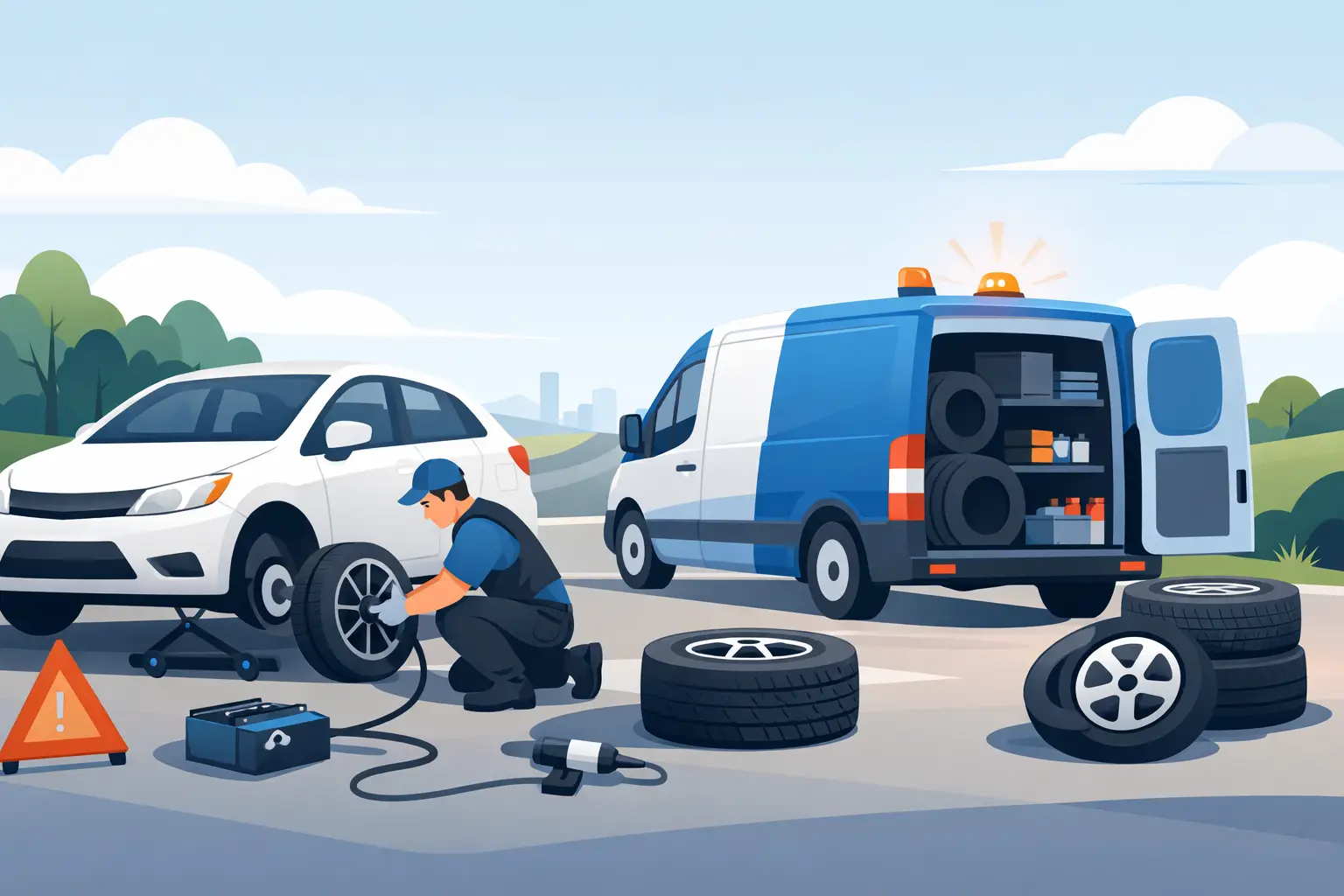
The work is then carried out where the vehicle is parked, whether that is at the roadside, at your workplace, or outside your home. With a properly equipped van, the fitter can remove the damaged tire, fit the replacement, check pressure, and make sure everything is road-safe before you set off again.
When roadside tire help is the right call
There is a big difference between an inconvenience and a safety risk. If you have a slow puncture and you are already at home, you may have time to book a planned visit. But if the tire has gone flat while you are out, the sidewall is damaged, or the car is stuck somewhere awkward, roadside assistance becomes the practical choice.
A roadside tyre fitting service is especially useful when the vehicle cannot be driven safely, when you do not have a usable spare, or when changing a wheel yourself is not realistic. Plenty of modern cars now come with repair kits instead of full spare wheels, and those kits are not much help if the tire has torn or the wheel has taken a hit.
It is also the better option when time matters. Missing a shift, a delivery slot, or the school pickup because of a damaged tire quickly becomes more expensive than the repair itself.
What the fitter will usually ask you
To get the right result first time, expect a few basic questions. Your location matters, of course, but so does the exact tire size. If you can read the numbers from the sidewall, that helps speed things up. The fitter may also ask for the vehicle make and model, whether the tire is completely flat, and whether the wheel or rim looks damaged.
Photos can help in some cases, especially if you are unsure how bad the damage is or the car is parked in a difficult spot. Clear communication saves time and helps avoid the frustration of a return visit for a different tire size.
Repair or replacement? It depends on the damage
This is where experience matters. Not every puncture means buying a new tire, but not every puncture can be repaired either. If the damage is in the central tread area and the tire has enough life left, a repair may be possible. If the puncture is too close to the sidewall, the sidewall itself is damaged, or the tire has been driven on while flat, replacement is usually the only safe route.
That can be frustrating if you were hoping for a quick low-cost fix, but it is better than gambling on a tire that could fail again. A decent mobile fitter should explain the reason clearly, not just push the most expensive option.
Some drivers also ask about part-worn tires. These can make sense if you need a lower-cost replacement and the tire has been properly tested and checked. For the right situation, they offer a practical middle ground between brand-new and not getting back on the road at all. The key is making sure they are legal, safe, and suited to the vehicle.
What affects the cost
Price is one of the first things people ask about, and fairly so. The total usually depends on the tire size, the brand or type of tire, whether it is a repair or a full replacement, and how urgent the callout is. A standard daytime visit for a common tire size is often much more reasonable than people expect. Larger vehicles, premium tires, or late-night emergency callouts can cost more.
Location also plays a part. If you are within a regular local service area, response and pricing are often better than they would be for a long-distance emergency call. The benefit, though, is that you avoid towing charges, garage delays, and the wasted time of arranging transport while the car is off the road.
When comparing cost, it helps to look at the full picture. A mobile service is not just about the tire itself. You are also paying for convenience, speed, and getting the problem solved where the car already is.
Why drivers choose mobile fitting over a garage
The obvious reason is convenience, but that only tells part of the story. A garage visit sounds simple until the tire is flat on your driveway, the car is stuck at work, or the puncture happens on a Sunday evening. At that point, getting to the garage becomes the problem.
Mobile fitting removes that extra step. The vehicle stays put, the fitter comes to you, and the work is done on site. For busy families, commuters, and tradespeople, that can save hours. For stranded drivers, it can turn a stressful situation into a manageable one.
That local, one-to-one service matters too. You are usually speaking directly with the person handling the job, not bouncing between a call center and a workshop desk. That makes updates clearer and the whole process less of a hassle.
Roadside tyre fitting service for emergency situations
Not every tire issue is a full emergency, but some definitely are. A blowout on a main road, a completely shredded sidewall, or a car stranded in an unsafe place needs a fast and sensible response. In those situations, the first priority is your safety. Pull over somewhere secure if you can, switch on your hazard lights, and avoid standing near moving traffic.
Once help is on the way, stay with the vehicle only if it is safe to do so. If the location feels dangerous, move to a safer spot nearby. A good mobile fitter will work with the conditions on site and let you know what they need from you before they arrive.
This is where speed and experience count. A fitter who regularly handles roadside callouts knows how to work efficiently, communicate clearly, and get the job done without adding confusion to an already stressful moment.
Choosing a service you can trust
When you need urgent help, you do not want vague promises. You want clear arrival times, honest advice, and someone who turns up prepared. Look for a service that offers practical communication, realistic pricing, and proper mobile equipment rather than just advertising emergency help without the setup to back it up.
Local reputation counts as well. Drivers tend to remember who answered quickly, who kept them updated, and who got them moving again without making the situation harder than it already was. That is one reason many people in Reading, Basingstoke, Bracknell, and nearby areas call Lee’s Mobile Tyres when a flat tire interrupts the day.
A roadside tire problem is never convenient, but it does not have to ruin your schedule or leave you stranded for hours. The right mobile service gets there, assesses the problem properly, and fixes what can be fixed without sending you all over town first. If your car cannot safely get to a garage, having the garage come to you is often the smartest move.