
What to Do With a Flat Tyre at Home
A flat tyre at home always seems to happen at the worst time – right before school drop-off, just as you’re leaving for work, or when the weather turns bad. The good news is that being stuck on your driveway is usually safer and easier to deal with than finding a flat on the roadside. The key is knowing what not to do, what to check, and when it makes more sense to call for help instead of making the problem worse.
First steps when you find a flat tyre at home
Start by leaving the vehicle where it is. If the tire looks completely flat, driving even a short distance across the street or to a nearby gas station can damage the sidewall, the wheel, and sometimes the tire pressure sensor too. What begins as a simple puncture repair can quickly turn into a full replacement if the tire has been driven on while deflated.
Take a quick look before you do anything else. If the tire is visibly squashed against the ground, if there’s a nail or screw in the tread, or if the sidewall has a split or bulge, that tells you a lot about whether the tire may be repairable. If the vehicle is parked on a slope, make sure it’s secure and avoid crawling around it unless it’s safe to do so.
If you have a tire pressure gauge, check the pressure. If not, a visual check is still useful. One tire sitting lower than the others is often enough to confirm the issue. You do not need to be a mechanic to spot a problem that needs attention.
Can you fix a flat tyre at home yourself?
Sometimes, yes. But it depends on the kind of damage, the tools you have, and how confident you are working on your car.
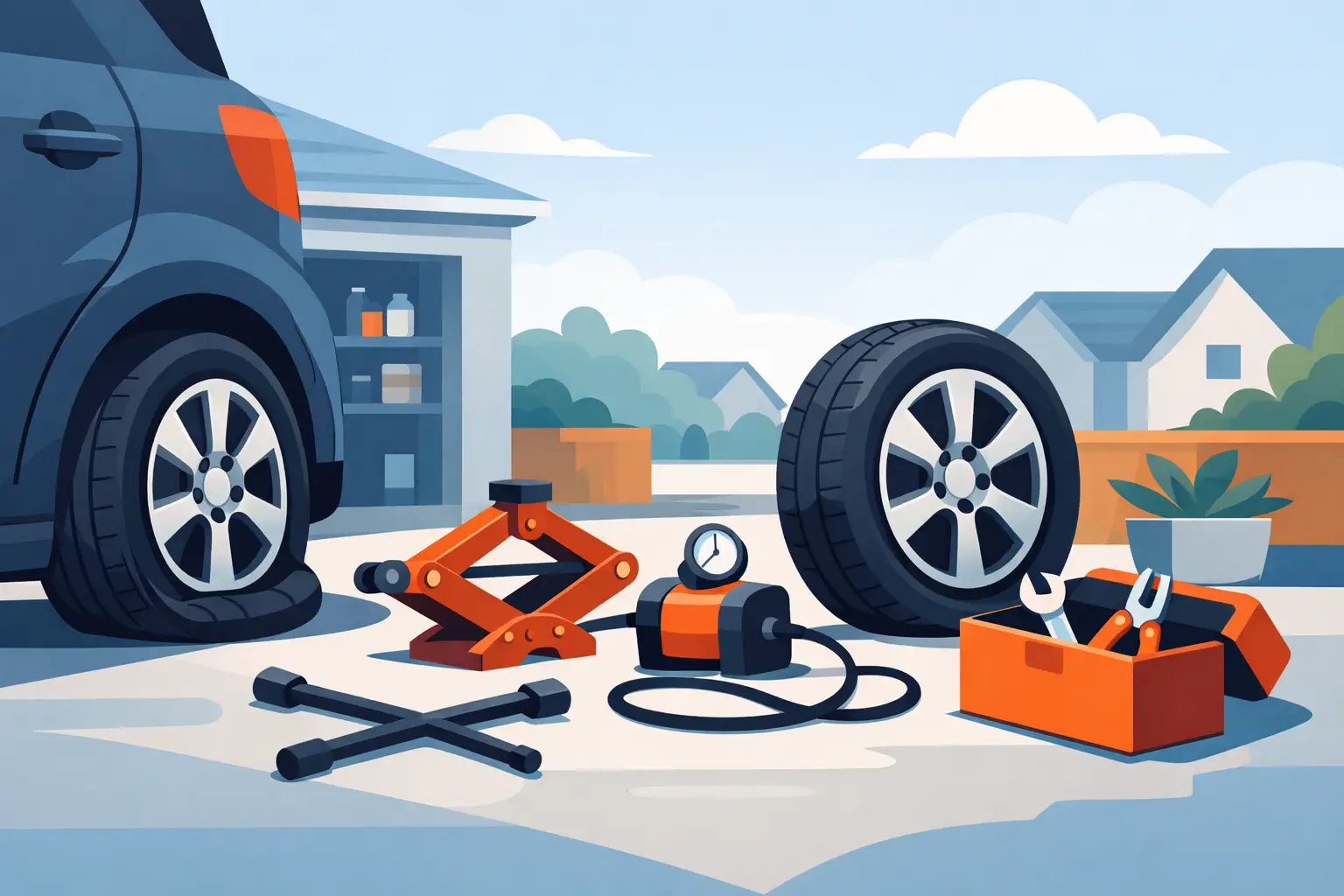
If your car has a spare tire, a jack, and a lug wrench, you may be able to change the wheel yourself. That can be a practical short-term answer if you know the spare is properly inflated and you’re comfortable fitting it safely. Even then, it is still a temporary measure in many cases, especially if the spare is a space-saver rather than a full-size wheel.
DIY repair kits are another option, but they have limits. Tire sealant can help with a small puncture in the tread area, but it will not solve a split sidewall, wheel damage, or a tire that has come off the rim. Some sealants can also make a proper repair messier afterward. If you’re dealing with a newer vehicle, it’s also worth checking whether the manufacturer recommends against using certain sealants with the tire pressure monitoring system.
If you are unsure, that usually tells you enough. A flat tire is not the best moment to learn by trial and error, especially if your car is parked awkwardly, your lug nuts are seized, or you simply do not have the time.
When not to drive on a flat tire
This is where a lot of people get caught out. A tire does not need to be fully collapsed to be unsafe. If the pressure is very low, the tire can flex too much, overheat, and break down internally as soon as you start moving. That damage is not always visible from the outside.
You should avoid driving if the tire is completely flat, if the sidewall is damaged, if the wheel itself looks bent, or if the car has been sitting on the flat for any length of time. The same applies if you hear hissing, see cords, or notice the tire has separated from the rim.
Even a short trip can cost you more than waiting for the right help. A repairable puncture is one thing. A ruined tire and damaged alloy are another.
What causes a flat tyre at home?
Not every flat happens while you are driving. Quite a few develop overnight or while the car is parked for hours.
A nail or screw picked up earlier in the day is a common cause. The object may stay lodged in the tread for a while before enough air escapes for you to notice. Slow punctures can be especially frustrating because the car may have seemed fine on the last trip.
Temperature changes can also expose an existing weakness. A marginal tire can lose enough pressure in colder conditions to look flat by morning. In other cases, the issue is around the valve, the wheel rim, or corrosion causing a poor seal between the tire and the wheel.
Then there is simple tire age. Older tires are more prone to cracking and failure, especially if the car is not driven regularly. A vehicle that sits for long periods can still end up with tire problems even when the mileage is low.
Repair or replacement – what usually makes sense?
That depends on where the damage is and what condition the tire is in overall.
A small puncture in the central tread area is often repairable if the tire has not been driven on flat. That is the best-case scenario. It is quicker, cheaper, and gets you back on the road without replacing a tire that still has plenty of life left.
If the puncture is in the shoulder or sidewall, replacement is usually the safer option. The same goes for tires with very low tread, visible cracking, repeated punctures, or internal damage from being run flat. Sometimes people hope a quick patch will do, but not every tire should be saved.
This is where an honest assessment matters. A reliable mobile fitter should tell you when a repair is suitable and when it is not, without making it more complicated than it needs to be.
Why mobile help is often the easiest answer
A flat tyre at home is exactly the kind of problem mobile tire fitting is built for. You are already in one place. The car is not safely drivable. The last thing most people want is to arrange a tow, find a ride, wait at a shop, and lose half a day over one tire.
With a mobile service, the work comes to you. That means the tire can be inspected, repaired if possible, or replaced on your driveway without the usual garage hassle. For busy families, commuters, and anyone trying to keep the day on track, that convenience is not a luxury. It is the difference between sorting the issue quickly and letting it turn into a bigger disruption.
There is also a safety benefit. A technician arrives with the right equipment, can deal with stubborn wheel nuts or damaged valves, and can usually spot problems that are easy to miss if you are trying to manage it yourself.
For local drivers around Reading, Basingstoke, and Bracknell, Lee’s Mobile Tyres is built around exactly this kind of callout – fast, straightforward help where the car is parked.
What to have ready before help arrives
You do not need to do much, but a few details can speed things up.
If you can, check the tire size on the sidewall. It will look something like 225/45R17. Knowing your location, vehicle make and model, and whether the tire is completely flat or just losing pressure helps too. If you can see the cause, such as a screw in the tread or damage to the sidewall, mention that when you call.
It also helps to park as safely as possible, especially if one side of the car is close to a wall or curb. If you have locking wheel nuts, make sure the key is easy to find. A lot of time gets lost searching through glove boxes and trunk compartments for that one small adapter.
How to reduce the chances of another flat at home
Not every puncture is preventable, but some flats are easier to avoid than people think.
Check your tire pressures regularly, not just when something feels wrong. A tire that is already low is more vulnerable to damage. Give the tread and sidewalls a quick look every couple of weeks, especially if the car is used for school runs, commuting, or carrying heavy loads.
If your car spends long periods parked, do not ignore the tires just because you are not driving much. Low use can still mean low pressure, sidewall aging, and trouble the next time you need the vehicle in a hurry.
And if one tire keeps losing air, get it looked at properly. Repeated top-ups are not a fix. They are usually a sign that something is going on that will eventually leave you stranded.
A flat tire at home is frustrating, but it is also one of the more manageable places for it to happen. You are not stuck on the shoulder and you do not need to take risks just to get moving. A calm check, the right advice, and proper help can turn an annoying start to the day into a problem that is handled on your driveway and out of your way.