What to Do With a Flat Tyre at Work
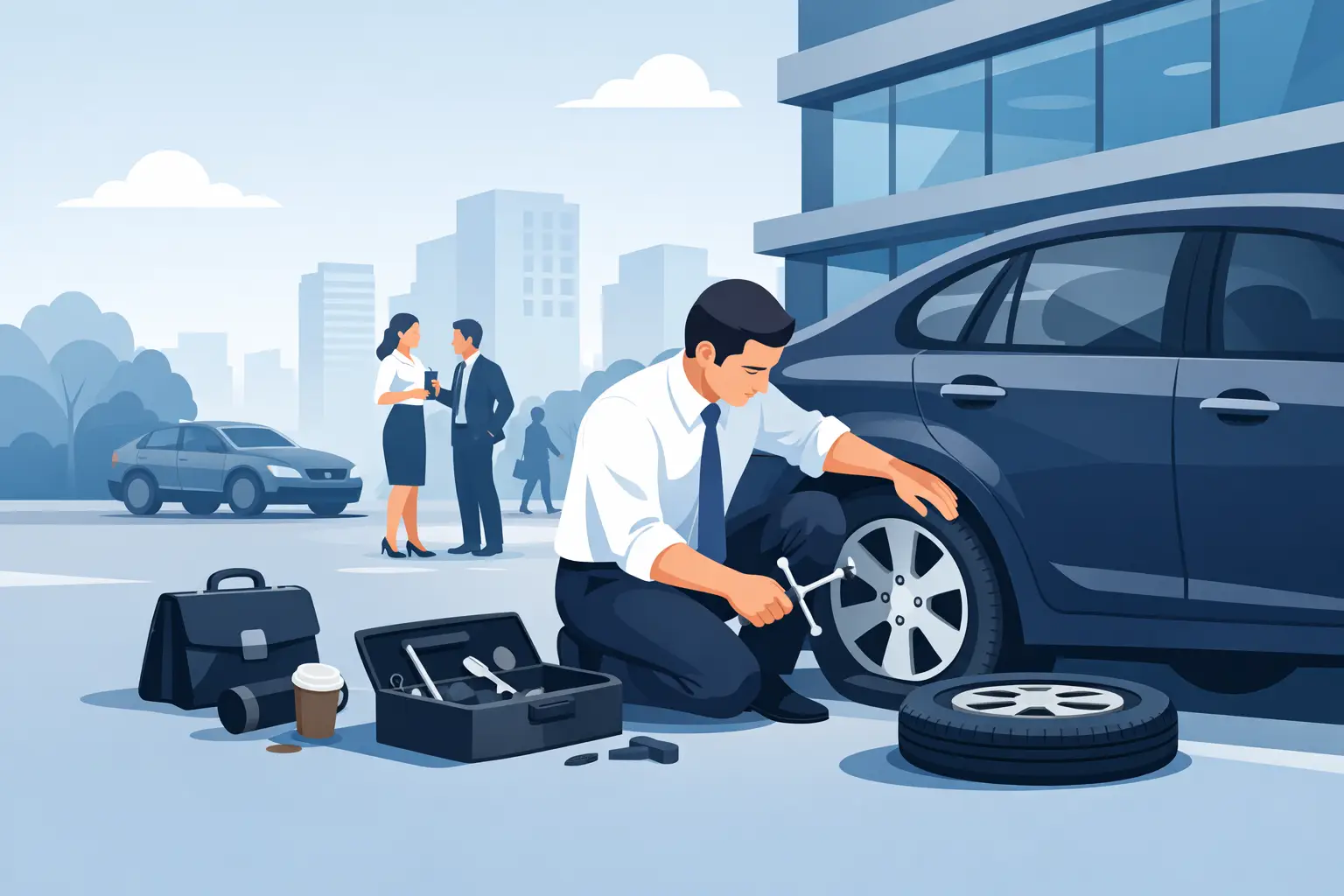
You finish your shift, head to the parking lot, and there it is – a flat tyre at work. It always seems to happen when you’re already short on time, need to pick someone up, or still have half the day planned. The good news is that a flat tire does not always mean your whole day is ruined. In many cases, it can be sorted where the car is parked, without waiting around at a garage.
First steps when you find a flat tyre at work
The first thing is simple: do not drive on it just to “get somewhere better.” If the tire is clearly low or fully flat, moving the vehicle can damage the sidewall, the wheel, and sometimes the tire pressure monitoring sensor as well. What could have been a repair can quickly turn into a full replacement.
Take a quick look at the tire before doing anything else. If there is a screw or nail in the tread, leave it where it is. Pulling it out can let the air escape faster. If the tire is shredded, split at the sidewall, or has come off the rim, it is no longer a repair job.
It also helps to think about where the vehicle is parked. A flat tire in a quiet office lot is one thing. A flat in a busy loading area, tight multi-story garage, or job site yard can be more awkward. Access matters because it affects how easily help can reach you and whether the work can be done safely on site.
Can you fix a flat tire yourself at work?
Sometimes, yes. Often, it is more hassle than people expect.
If your car has a spare, jack, and wheel wrench, and you are confident using them, you may be able to swap the wheel yourself. But plenty of drivers either do not have a spare anymore or have a temporary spare with strict speed and distance limits. Many newer vehicles come with inflation kits instead, and those are only useful in certain puncture situations.
There is also the practical side. Not every workplace parking lot gives you enough room to kneel beside the car safely. Bad weather, poor lighting, soft ground, sloped spaces, and traffic around the vehicle all make a simple wheel change less simple. If you are dressed for the office or carrying tools for a different job, changing a tire may be the last thing you want to deal with.
That is why mobile tire help makes sense for many drivers. Rather than limping to a shop or trying to solve it with whatever is in the trunk, you can have the tire checked, repaired, or replaced where the car is already parked.
When a flat tyre at work can be repaired
A lot depends on the location and type of damage. If the puncture is in the central tread area and the tire has not been driven on while flat, there is a fair chance it can be repaired. That is the best-case outcome because it is usually quicker and cheaper than replacing the tire.
If the damage is in the sidewall or shoulder, repair is generally off the table. The same applies if the tire has a large split, serious internal damage, or the tread is already too worn. In those cases, replacement is the safe option.
This is where having someone inspect it properly matters. From a distance, two flat tires can look the same. One may take a simple puncture repair, while the other is beyond saving. Guessing is not worth it when your safety depends on the result.
Why mobile tire fitting is often the easiest option
If you are stuck with a flat tire at work, convenience matters just as much as price. You are not looking for a long process. You want the car sorted so you can get on with your day.
Mobile tire fitting cuts out the biggest headache, which is getting the vehicle to a shop in the first place. There is no arranging a tow, no waiting for a friend, and no losing half a day sitting in a waiting room. A technician comes to your workplace, checks the damage, and carries out the work on site if conditions allow.
For busy commuters, parents, tradespeople, and shift workers, that can make a real difference. Your car stays where it is. You stay at work or finish what you need to do. Once the job is done, you can drive away safely.
That is also why local service matters. A nearby mobile tire fitter can usually respond faster than a company traveling in from farther out. In urgent cases, speed is not just a nice extra. It is the whole point.
What to expect from an on-site tire visit
Most drivers have never used mobile tire fitting until they need it. The process is usually more straightforward than people think.
You give your location, vehicle details, and as much information as you can about the tire problem. If you know the tire size, that helps, but it is not always essential right away. A good mobile fitter will confirm what is needed before coming out or bring likely options if a replacement looks necessary.
Once on site, the tire is inspected first. That determines whether the job is a repair or a replacement. If replacement is needed, the new tire is fitted and balanced. The aim is not just to get air back in the tire, but to leave you with a safe, road-ready result.
At Lee’s Mobile Tyres, that is exactly the kind of job the service is built for – meeting drivers where they are and sorting the problem without sending them across town to a garage.
Should you use a part-worn tire?
This depends on your budget, your timeline, and the condition of the available tire.
A quality part-worn tire can be a practical option if you need to keep costs down and want to get moving again without overspending. The key word is quality. It should be properly tested, safe, and legal, with enough usable tread left to make it worthwhile.
For some drivers, a new tire is the better call, especially if the matching tire on the other side is fairly new or if they do a lot of high-mileage driving. For others, a tested part-worn tire is a sensible short-term or budget-friendly answer. There is no one-size-fits-all rule. The right choice depends on the vehicle, the remaining tread on the other tires, and how the car is used.
How to avoid getting stranded again
Not every flat tire can be prevented, but some can.
Checking your tire pressure regularly makes a bigger difference than most people realize. Underinflated tires run hotter, wear faster, and are more vulnerable to damage. A quick pressure check every few weeks is easier than dealing with a flat in a work parking lot after a long day.
Tread depth matters too. Worn tires are more likely to pick up damage and less likely to cope well with rough roads or debris. If your tires are already close to replacement, a puncture often becomes the final push rather than a one-off problem.
It is also worth giving the tires a quick visual check now and then. If you spot a screw in the tread before the tire goes fully flat, you may be able to get it repaired before it leaves you stuck.
The main thing is not to make it worse
A flat tire can feel like a small problem until it turns into a bigger one. Driving on it, trying a rushed repair, or ignoring visible damage can all increase the cost and the downtime.
The better move is usually the simpler one: stop, assess the tire, and get the right help to the vehicle. If it can be repaired, great. If it needs replacing, you want that done properly and safely the first time.
A flat tyre at work is frustrating, but it does not have to derail your whole day. With the right response, it can be handled where you are, without the extra stress of getting to a shop first. If you find yourself stuck in the parking lot staring at a flat, the best next step is usually the one that gets you safely moving again with the least disruption.