24 Hour Tyre Emergency Guide for Stranded Drivers
A flat tire rarely happens at a convenient time. It is often on the school run, before work, in a dark parking lot, or when you are already late. This 24 hour tyre emergency guide gives you a clear plan: protect yourself first, avoid further vehicle damage, and get the right help to move again safely.
24 Hour Tyre Emergency Guide: What to Do First
The moment you notice a problem, ease off the accelerator and keep a firm grip on the steering wheel. A sudden pull to one side, heavy vibration, a thumping sound, or a tire pressure warning light can all point to a puncture or tire failure. Do not brake sharply unless you need to avoid an immediate hazard.
Find the safest available place to stop. A parking lot, service area, side street, or wide lay-by is far better than the edge of a busy road. Turn on your hazard lights, apply the parking brake, and make sure passengers leave the vehicle only if it is safe to do so. On a fast road or in poor visibility, staying safely away from moving traffic matters more than inspecting the tire straight away.
Once stopped, look at the affected wheel from a safe position. You may see a completely flat tire, a nail or screw in the tread, a split sidewall, or damage to the wheel itself. There is no need to touch the tire or pull out an object lodged in it. Removing a nail can turn a slow loss of pressure into a rapid deflation.
Do Not Keep Driving on a Flat Tire
It can be tempting to drive a short distance home, to a gas station, or to the nearest garage. That decision can turn a repairable puncture into a full tire replacement. A tire driven while flat can be damaged internally, even if the outside does not look too bad afterward.
Driving on a flat can also damage the wheel rim, affect handling, and put extra strain on other parts of the vehicle. If the tire has come off the rim, is shredded, has a sidewall bulge, or has suffered a blowout, the vehicle should not be driven at all.
There are exceptions, but they depend on the vehicle. Some cars have run-flat tires that may allow limited driving at a reduced speed and distance. The exact limits are set by the tire and vehicle manufacturer, so check your handbook or the information in your vehicle. Do not assume every low-profile tire or modern vehicle has run-flat capability.
Decide Whether a Spare Is the Right Answer
If you have a usable spare tire, are parked on level ground away from traffic, and know how to fit it safely, using the spare can get you moving. Check its condition and pressure before relying on it. Many temporary spare tires have lower speed limits and are only intended to get you to a repair or replacement service.
However, a spare is not always the best solution. Many newer vehicles do not carry one. Some have only an inflation kit, which will not help with a split sidewall, a large hole, or a damaged rim. Changing a wheel beside a busy road, in heavy rain, or after dark brings its own risks.
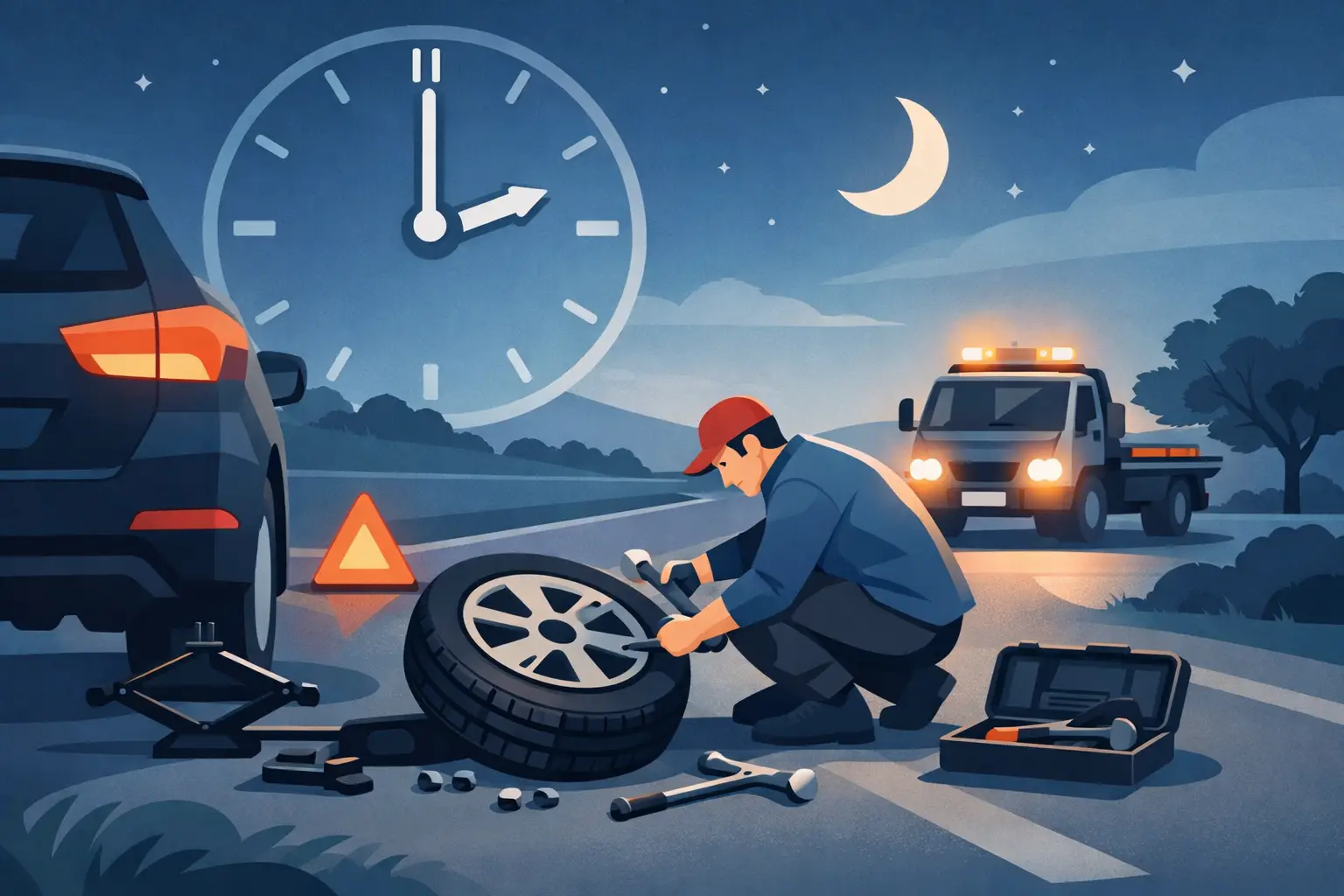
If there is any doubt about your location, the condition of the spare, or your ability to change the wheel safely, call for mobile tire assistance instead. Waiting somewhere safe is usually a better choice than rushing a wheel change in a dangerous spot.
What a Mobile Tire Technician Needs to Know
A good callout starts with accurate information. You do not need to be a tire expert, but a few details help the technician arrive prepared and avoid delays.
Have these details ready when you call:
- Your exact location, including a nearby landmark, road name, or parking lot entrance
- Your vehicle make, model, and license plate number
- The tire size, if you can read it from the sidewall or vehicle placard
- Which tire is affected and whether it is flat, damaged, or has a puncture
- Whether you have a locking wheel nut key and where it is kept
The tire size is usually written as a sequence such as 225/45 R17. If you cannot find it, do not worry. Your vehicle details can often help identify the correct fitment, though confirming the size is always useful.
Be honest about the situation. Say if the vehicle is in a tight underground garage, on a driveway, parked against a curb, or carrying a heavy load. These details help the technician plan the job properly and bring the right equipment.
Repair or Replacement: What Can Be Done at the Roadside?
Not every puncture needs a new tire. A puncture in the central tread area may be repairable if the tire has not been driven flat and the damage is within safe repair limits. A proper assessment includes checking the tire from the inside, not just plugging a hole from the outside.
A tire normally needs replacing when there is sidewall damage, a bulge, visible cords, a large cut, severe tread wear, or internal damage caused by driving while deflated. Tires with punctures too close to the shoulder may also be unsafe to repair.
The right option depends on condition, availability, and your budget. A new tire may be the best choice for long-term use, especially where matching tread depth and tire type matters. A fully inspected part-worn tire can sometimes be a practical, lower-cost option when you need to get safely back on the road and the correct size is available.
For all-wheel-drive vehicles, tire matching deserves extra care. A major difference in tread depth or tire circumference across the same axle, and sometimes across all four wheels, can affect the drivetrain. Tell the technician if your vehicle is AWD, 4WD, or has performance tires so they can advise you properly.
Keep Yourself Safe While You Wait
After calling for help, make yourself easy to find without putting yourself in harm’s way. Keep your phone charged if possible and watch for updates from the technician. If you are on a roadside, do not stand between the vehicle and traffic, and do not sit in a position where another vehicle could strike yours from behind.
At home or work, move valuables out of the way around the affected wheel and make sure the technician has enough room to work. If wheel locking nuts are fitted, find the key before help arrives. It is commonly stored under the trunk floor, with the spare tire tools, in the glove compartment, or in a small pouch.
If you are stranded with children, elderly passengers, or someone who is vulnerable, prioritize warmth, visibility, and a safe waiting place. A flat tire is frustrating, but there is no benefit in making a risky decision to save a few minutes.
Prevent the Next Tire Emergency
Most tire emergencies cannot be predicted, but a few simple checks reduce the odds of being caught out. Check tire pressures at least once a month and before a long journey, using the pressure recommended for your vehicle rather than the maximum printed on the tire. Inspect tread for uneven wear, cuts, screws, and cracking.
Pay attention to changes in how the vehicle feels. Repeated vibration, pulling under braking, a steering wheel that is off-center, or rapid wear on one edge of a tire can point to wheel balance, alignment, suspension, or pressure problems. Dealing with these early can save money and improve safety.
It also helps to know what equipment your vehicle has before an emergency happens. Check whether you carry a spare, a sealant kit, locking wheel nut key, and wheel tools. Do this in daylight on a calm day, not for the first time on the roadside at night.
For drivers around Reading, Basingstoke, Bracknell, and nearby areas, Lee’s Mobile Tyres can bring tire fitting, puncture assessment, balancing, and emergency replacement directly to your location. That means less time arranging a tow or sitting in a waiting room when your vehicle cannot move.
A tire problem does not need to take over your whole day. Stop safely, avoid driving on damage, give clear information when you call, and let the right person assess the tire before you set off again.