Spare Wheel Fitting Service When You Need It
A flat tire can turn an ordinary school run, commute, or workday into a problem fast. If your vehicle has a usable spare, a spare wheel fitting service can get it fitted where you are – at home, at work, or safely at the roadside – without the hassle of arranging a tow or trying to do the job yourself.
For most drivers, the goal is simple: get moving again safely, with as little disruption as possible. That is exactly what mobile tire help is for. A trained technician comes with the right equipment, checks the wheel and tire situation, fits the spare if it is safe to do so, and makes sure you are not sent back on the road with obvious problems overlooked.
When a spare wheel fitting service makes sense
A spare is useful, but fitting one is not always as straightforward as it looks. The lug nuts may be very tight, the locking wheel nut key may be needed, the vehicle may be parked on uneven ground, or you may simply not feel comfortable lifting a car at the side of a busy road.
A mobile spare wheel fitting service is a sensible option when you have a flat but your spare is in good condition, properly inflated, and suitable for the vehicle. It is also a practical choice if time is short. You should not have to lose half a day sitting in a tire shop when help can come to your driveway or workplace.
It is especially helpful for parents with children in the car, tradespeople who need their van back on the road, commuters stuck before work, and anyone who has been caught out after normal garage hours. Lee’s Mobile Tyres serves motorists around Reading, Basingstoke, Bracknell, and nearby areas with the kind of direct, local help that makes a stressful situation more manageable.
First, check whether the spare is safe to use
Not every spare wheel is ready to go. Before fitting it, a technician should check that it has enough air, that the tire is not cracked or badly worn, and that it is the correct size and type for the vehicle. A spare that has been sitting under the trunk floor for years may look fine at a glance but still be unsuitable.
There are generally two types of spare. A full-size spare is closer to a normal road wheel and may be used in much the same way, provided it is in sound condition. A compact temporary spare, sometimes called a space-saver, is designed only to get you to a tire repair or replacement appointment.
If you have a temporary spare fitted, follow the speed limit shown on its label. Many are limited to 50 mph, and they should not be treated as a permanent replacement. They can affect handling, braking, traction control, and the way the car feels, particularly in wet weather. The safest plan is to use it for the shortest necessary trip and arrange a proper tire repair or replacement as soon as possible.
What happens during a mobile spare wheel fitting
The job starts with making the location safe. On a roadside callout, that may mean choosing the safest available position, using hazard lights, and keeping people away from traffic. A good technician will not take risks with a vehicle that is poorly positioned or on unstable ground.
The flat tire is then inspected. Sometimes the cause is clear, such as a screw in the tread, a split sidewall, or damage from a pothole. This matters because it helps decide whether the tire could later be repaired or whether replacement is the only safe option.
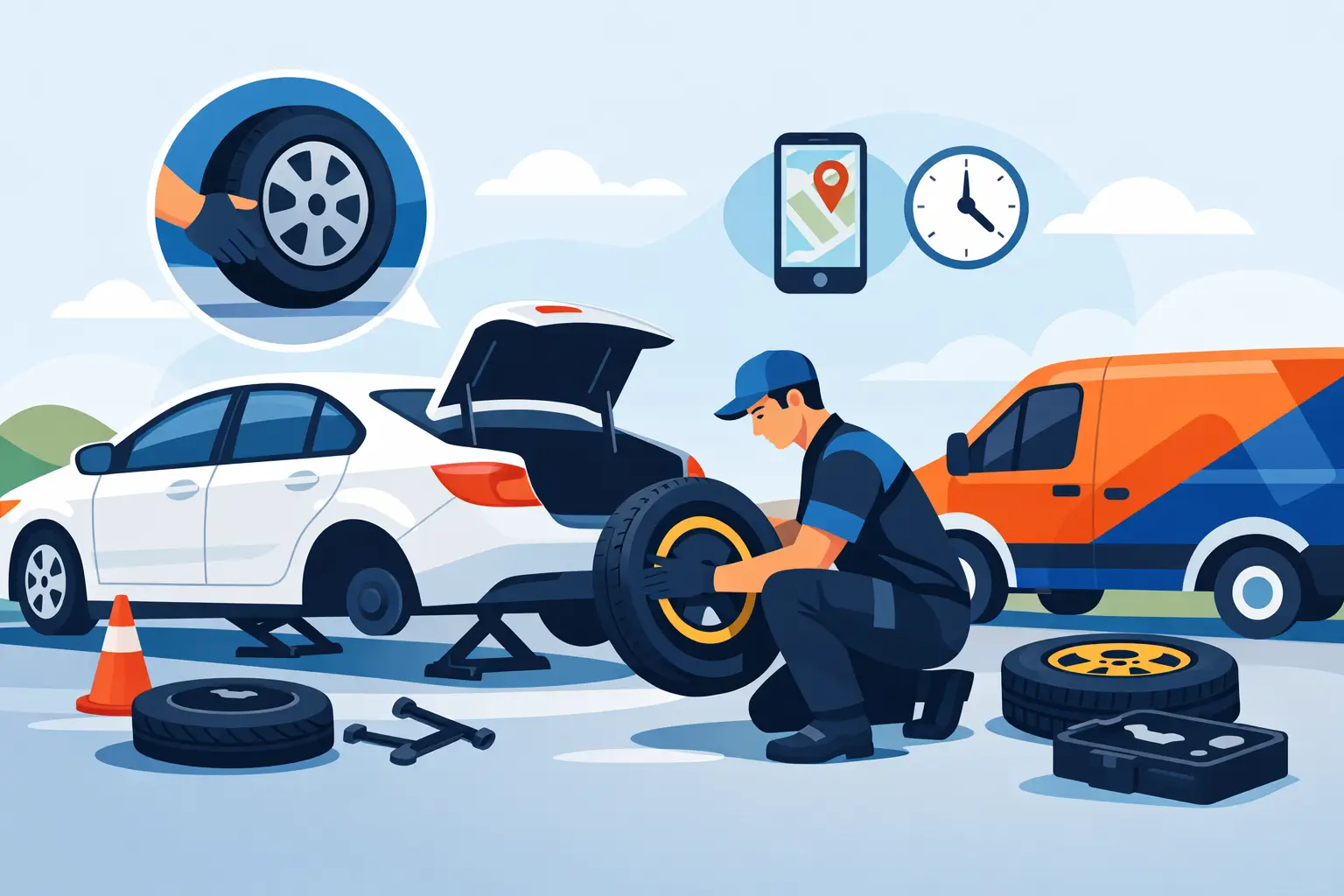
The vehicle is lifted using the correct jacking point, the damaged wheel is removed, and the spare is installed. Wheel nuts are tightened properly, rather than simply being forced on as hard as possible. The tire pressure is checked where appropriate, and the driver is told whether the fitted spare has any speed or distance restrictions.
If your wheels use locking lug nuts, make sure the locking key is in the car if you can find it. It is often kept in the glove compartment, trunk tool kit, under the trunk floor, or with the vehicle paperwork. Without it, removing the wheel can take longer and may need a different solution.
A spare is not always the best answer
It depends on the damage, the vehicle, and the spare you have available. If there is no spare, the spare is flat, or the spare has deteriorated, a mobile tire replacement may be the better option. In some cases, a puncture repair can save a tire and cost less than replacing it, but only if the damage is in the repairable part of the tread and the tire has not been driven flat for too long.
Sidewall cuts, large holes, exposed cords, and damage caused by driving on a deflated tire usually mean replacement is needed. Trying to keep driving on a severely damaged tire can ruin the tire completely and may damage the wheel as well.
For vehicles with all-wheel drive, tire matching can also matter. A single replacement tire with a very different tread depth can sometimes affect the drivetrain. This is not a reason to stay stranded, but it is worth discussing with a tire professional before choosing the final replacement.
What to do while you wait for help
If you are in a dangerous position, such as on a highway shoulder or close to fast-moving traffic, move yourself and passengers to a safer place where possible. Do not stand beside the vehicle facing traffic, and do not attempt a wheel change if the ground is soft, sloped, or unsafe.
Have your vehicle details ready: the make, model, registration number, wheel size if known, and your exact location. A photo of the flat tire can also be useful, especially if there is visible damage. Let the technician know whether you have a spare, whether the wheel has locking lug nuts, and whether the vehicle is carrying a heavy load.
Avoid driving on a completely flat tire unless moving a very short distance is necessary to get out of immediate danger. Even a short drive can turn a repairable puncture into a tire that must be replaced.
Keep your spare ready before you need it
The easiest roadside call is the one that goes quickly because the spare is ready. Check it a couple of times a year, not just after you get a puncture. Look for cracking, check the pressure, and make sure the jack, wheel brace, and locking nut key are present.
It is also worth checking whether your car actually has a spare. Many newer vehicles come with a tire repair kit instead, while others may have run-flat tires. Those options can work in some situations, but they do not always solve every puncture or sidewall damage issue. Knowing what is in your vehicle before a flat happens removes one worry from an already frustrating day.
A flat tire rarely arrives at a convenient time. Keep your spare checked, keep the locking key where you can find it, and if the job is not safe or practical to handle yourself, get someone mobile to come to you and put the next step back within reach.