What to Do During Nighttime Tyre Callouts
A flat tire feels very different at 2 a.m. than it does outside your house on a Saturday morning. Visibility is poor, most garages are closed, and a simple puncture can quickly become a safety concern. That is why nighttime tyre callouts are about more than replacing a damaged tire – they are about getting you, your passengers, and your vehicle out of a difficult situation safely.
Whether you are parked at home, finishing a late shift, or stopped at the roadside near Reading, Basingstoke, or Bracknell, the first few minutes matter. Stay calm, make your location safe, and avoid trying to force the journey onward on a flat tire.
Make Yourself Safe Before Looking at the Tire
If you notice a sudden pull through the steering wheel, a thumping noise, or a tire-pressure warning light, ease off the accelerator. Do not brake sharply unless you have to. Hold the wheel steadily, indicate, and move to the safest available place.
On a normal road, that may mean a well-lit parking area, a side street with room to stop, or a driveway if you are close to home. Avoid stopping on a bend, near a junction, or anywhere other drivers will see you late. Turn on your hazard lights as soon as you are slowing down or stopped.
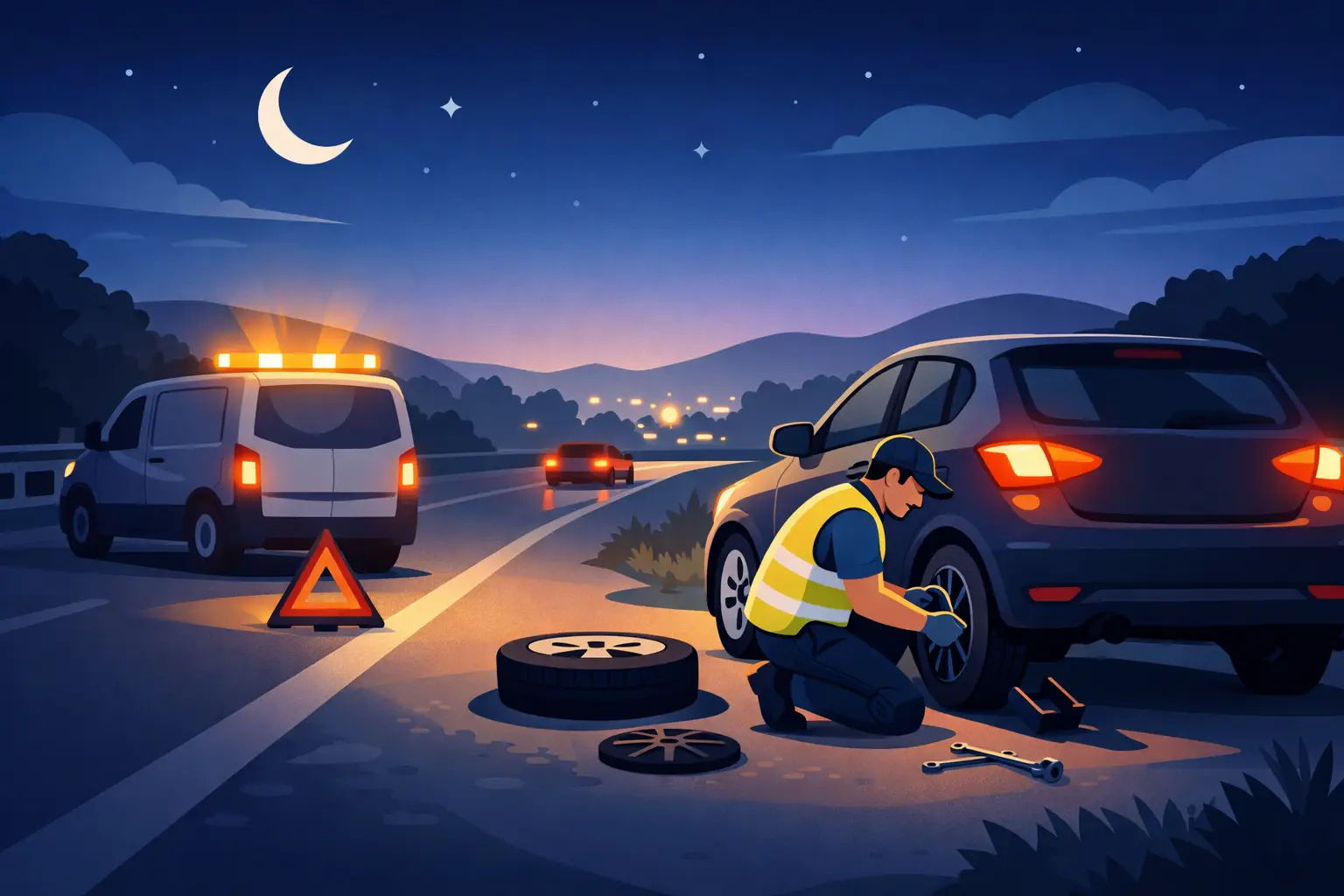
If you are on a high-speed road, do not attempt to inspect or change the tire beside moving traffic. Get behind a barrier if there is one and, when it is safe, move passengers away from the vehicle. A nighttime tire problem is inconvenient, but standing close to live traffic is far more dangerous than waiting for help.
Once parked, apply the parking brake, put the vehicle in park or in gear, and keep your doors locked if you are in an unfamiliar area. If you need to step out to check the tire, use a flashlight or your phone light and stay aware of vehicles around you.
When a Nighttime Tyre Callout Is the Right Choice
A spare wheel can be useful, but it is not always the best answer after dark. Many newer vehicles do not carry one. Others have a temporary spare with speed and distance limits, while some drivers understandably do not feel comfortable using a jack on uneven ground in poor light.
A mobile tire callout makes particular sense when the tire is completely flat, the sidewall is damaged, the wheel has been hit by a pothole, or you do not have a safe place to work. It is also a practical option if you have children in the car, have just finished work, or need the vehicle ready for an early start.
Not every puncture needs a replacement. A small puncture in the central tread area may be repairable if the tire has not been driven flat and the damage meets repair standards. A split sidewall, exposed cords, a large tear, or damage around the shoulder usually means replacement is the safer route.
That distinction matters because a quick fix is only worthwhile if it remains safe after you drive away. A good mobile technician should inspect the tire properly, explain whether a repair is suitable, and give you a clear option when it is not.
What Information Helps Get Help to You Faster
When you make a nighttime tyre callout, a few clear details can save time and prevent the wrong tire from arriving. Start with your exact location. A street name and house number are ideal, but a nearby store, gas station, roundabout, or recognizable landmark can help if you are at the roadside. Your phone map location is useful when you are somewhere difficult to find.
Next, describe the problem as simply as possible. Is the tire flat? Has it blown out? Is there a screw in the tread? Did you hit a curb or pothole? If you know the tire size, share it. The size is printed on the sidewall and looks similar to 225/45 R17. A clear photo of the sidewall can also help identify what is needed.
Let the technician know your vehicle make, model, and whether you have locking wheel nuts. If you do, check whether the locking wheel nut key is in the glove box, trunk, or with the spare-wheel tools. Without that key, removing the wheel can take longer.
You should also be upfront about the setting. A tire change on a driveway is different from one in a dark public parking lot or on a narrow roadside. Clear information allows the mobile service to arrive prepared and assess the safest way to carry out the work.
Do Not Turn a Flat Tire Into a Bigger Repair
Driving even a short distance on a flat tire can destroy it. The weight of the vehicle crushes the sidewall against the wheel, creating internal damage that may not be obvious from the outside. What might have been a simple puncture repair can become a replacement tire and, in some cases, a damaged wheel.
Do not keep topping up a tire that is losing air quickly and hope it will make the trip home. If the pressure warning returns shortly after inflation, treat it as an active problem. The same applies if the vehicle feels unstable, the steering becomes heavy, or you can hear the tire flapping.
Be careful with tire sealant too. It can provide a short-term solution for a small tread puncture, but it will not repair sidewall damage or a blowout. It may also make a later repair harder, depending on the tire and the amount used. If you use sealant, tell the technician before any work begins.
What a Mobile Tire Technician Can Do at Night
The best nighttime service is straightforward: assess the tire, make the vehicle safe, and get you moving without a garage visit. Depending on the damage and your vehicle, that can mean a puncture repair, fitting a replacement tire, installing your spare, or checking the wheel for damage.
Mobile service is especially useful because the work happens where the problem occurred. There is no need to arrange a tow just to reach a tire shop, no need to leave your car overnight, and no need to take time off work for a garage appointment the following day.
For customers who need a more budget-conscious option, a fully inspected part-worn tire can sometimes be a sensible choice. It depends on the size needed, the condition available, and how you use the vehicle. For regular high-mileage driving, matching tires with good tread and the correct specification should always take priority over the cheapest immediate option.
Lee’s Mobile Tyres provides practical 24/7 support for drivers who need help at home, at work, or roadside. The aim is not to make a stressful night more complicated. It is to assess the problem honestly, fit the right safe solution where possible, and help you get on with your journey.
Preparing for Future Nighttime Tyre Callouts
You cannot prevent every puncture, but a small amount of preparation reduces the stress. Check tire pressures regularly, including the spare if you have one. Look for nails, cuts, bulges, and uneven wear when you wash the car or fill up. A tire that is already worn thin is more vulnerable to road debris and potholes.
Keep a flashlight, warm layer, reflective vest, phone charger, locking wheel nut key, and your vehicle’s wheel tools in the car. You may never need them, but they are useful if you are stopped after dark. It is also worth knowing where your tire-pressure warning reset function is located, although resetting the light should only happen after the underlying issue has been addressed.
If a tire goes down tonight, do not rush into a risky roadside repair or drive farther than you should. Get somewhere safe, share your location clearly, and let the right help come to you. A flat tire may interrupt your plans, but it does not have to leave you stranded.