
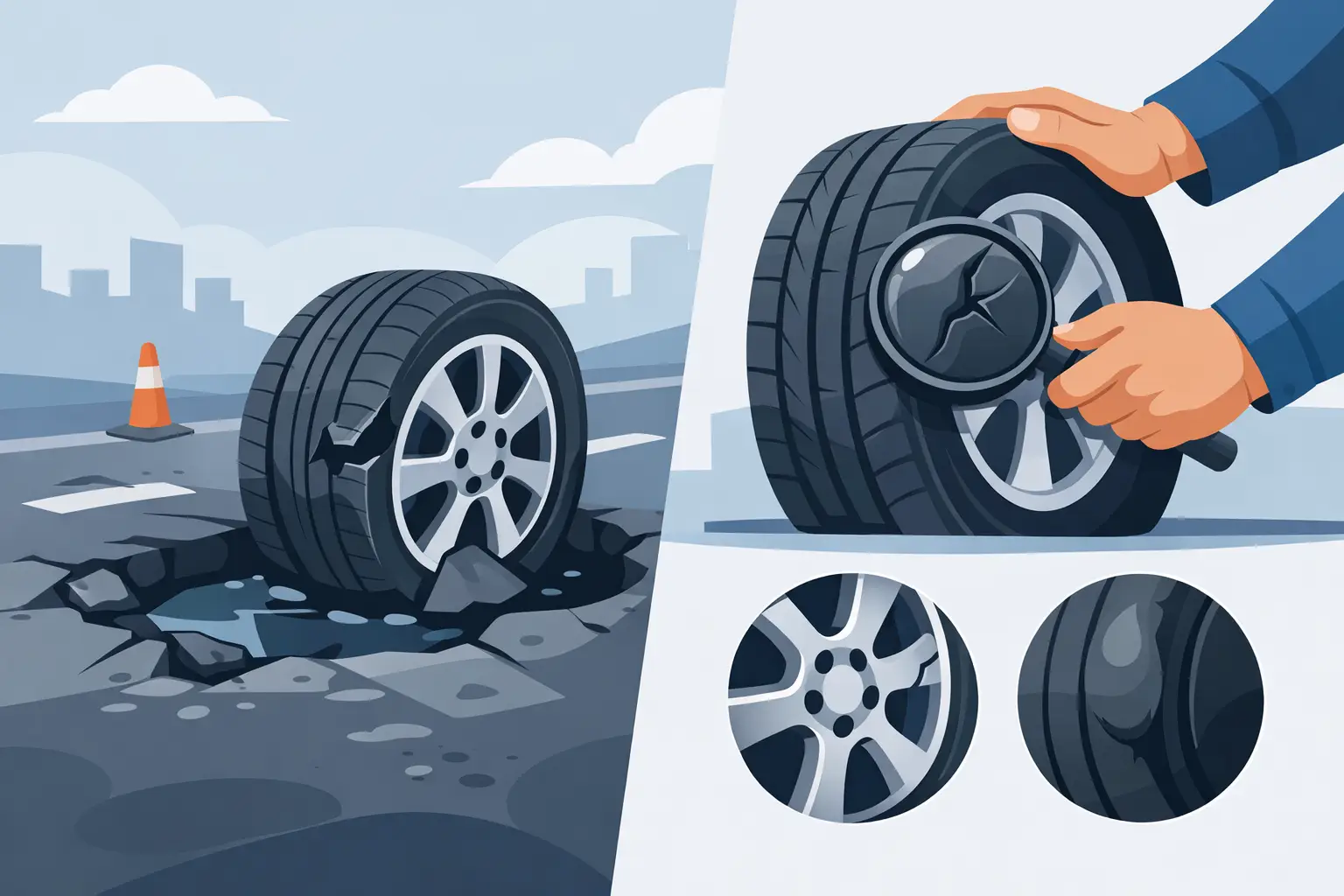
Tyre Damage From Potholes: What to Check
You usually know the moment it happens. One hard hit, a sharp thud through the cabin, and suddenly the car doesn’t feel quite right. Tyre damage from potholes can show up straight away, or it can wait until you’re halfway to work, on the school run, or heading home late and least able to deal with it.
That is what makes pothole damage so frustrating. Sometimes the tire looks fine at first glance, but the impact has already weakened the sidewall, knocked the wheel out of balance, or caused a slow air leak. If your steering feels off, the car starts vibrating, or the tire pressure warning comes on after a pothole hit, it is worth taking seriously.
Why tyre damage from potholes happens so easily
Modern tires are tough, but they are not indestructible. A pothole creates a sudden impact between the tire and the edge of the wheel. If the hole is deep enough or the speed is high enough, the tire gets pinched hard against the rim. That can damage the internal structure even if the tread still looks usable.
Low-profile tires are especially vulnerable because there is less sidewall to absorb the shock. Heavier vehicles can also suffer more damage because there is more force going through the wheel on impact. Speed matters too. A pothole you might roll over at low speed can do real harm if you hit it faster than expected.
Weather adds another layer. Rainwater hides depth, so what looks like a shallow puddle can be a sharp-edged hole. Cold weather can make road surfaces break up faster, which is why pothole problems often seem to pile up all at once.
Signs your tire may be damaged after a pothole
The most obvious sign is an immediate flat or rapid loss of pressure. In that case, there is not much debate. The tire needs attention straight away, and driving on it risks destroying the tire completely and damaging the wheel.
Some signs are less dramatic. You may notice a bulge in the sidewall, a cut, a scuff deep enough to expose damage, or a slow leak over the next few hours. A sidewall bulge is a big red flag. It usually means the internal cords have been damaged, and the tire is no longer structurally sound.
Other times, the tire is not the only issue. If the steering wheel shakes, the car pulls to one side, or the ride feels harsh after the impact, the wheel may be bent or the alignment may be off. Potholes do not always pick just one part to damage.
What to check right away
If you can stop somewhere safe, start with a basic visual check. Look at the sidewall closely, not just the tread. Bulges, splits, or deep scrapes matter more than a bit of surface marking. Check whether the tire is sitting lower than the others, even if it is not fully flat.
Then look at the wheel itself. Cracks are less common, but bends and dents around the rim are not unusual after a hard hit. If the wheel edge is damaged, the tire may not seal properly even if the rubber looks passable.
Pay attention to how the car felt before you stopped. Vibration, pulling, thumping, or a new wobble all tell you something. If the car drove normally before the pothole and feels different after it, trust that change. Drivers often talk themselves into hoping it is nothing. Sometimes it is minor. Sometimes it is the start of a roadside problem ten miles later.
When it is safe to keep driving – and when it is not
This is where a lot depends on what you see and what the car is doing. If the tire has lost pressure quickly, shows a sidewall bulge, has visible damage, or the car feels unstable, do not keep driving unless you are moving only a very short distance to get fully out of danger. Continuing on a damaged tire can turn a repairable situation into a full replacement, and it can put you at risk of a blowout.
If there is no visible damage and the car feels normal, you may be able to continue carefully, but it is still smart to have the tire checked as soon as possible. Pothole damage is not always obvious from the outside. Internal damage can take time to show itself.
The middle ground is the tricky part. A slow loss of air, slight vibration, or a wheel that now feels off-center might not leave you stranded immediately, but those are not symptoms to ignore for days. If your plans allow, get it looked at the same day.
Can a pothole-damaged tire be repaired?
Sometimes yes, sometimes no. If the pothole caused a standard puncture in the repairable area of the tread, a proper repair may be possible. But if the damage is in the sidewall, or if the internal structure has been compromised, repair is not the safe option.
Sidewall bulges are the clearest example. They are not patch jobs. They mean the tire has been weakened and should be replaced. The same goes for splits, severe sidewall cuts, or impact damage that has distorted the shape of the tire.
The wheel also matters. A tire fitted to a bent wheel may keep losing pressure or wear unevenly. In some cases the tire needs replacing, but in others the bigger issue is the rim or the alignment knocked out by the impact. That is why a proper inspection matters more than a quick guess.
Hidden problems that show up later
Not all tyre damage from potholes is instant and obvious. You might carry on driving and only notice problems later in the week. Uneven wear is one common sign, especially if the impact has affected alignment. What starts as a slight pull to one side can become a tire wearing out far sooner than it should.
Another delayed issue is a slow leak from wheel damage. The tire may hold enough air to get you around for a bit, then keep needing top-ups. Some drivers assume they picked up a nail, but the real cause is the pothole impact compromising the seal.
Suspension damage is also possible after a hard hit. That sits beyond the tire itself, but it can show up through the way the vehicle handles. If the impact was severe and the car feels wrong even after the tire pressure is corrected, the tire may not be the only part needing attention.
How to reduce the risk next time
No one avoids every pothole. Around town, on dark roads, or in standing water, some are impossible to spot in time. But a few habits help reduce the odds of serious damage.
Keeping your tires properly inflated is one of the biggest ones. Underinflated tires are more vulnerable because they compress more easily against the rim on impact. Driving at a sensible speed on damaged roads also gives the tire a better chance of absorbing the hit.
It is also worth watching the vehicle in front without following too closely. That gives you a better view of the road surface and more time to react. Swerving at the last second is not always the answer, though. If traffic is around you, a controlled straight-line hit can be safer than a sudden move into another lane.
What drivers usually get wrong
The most common mistake is assuming that if the tire is not flat, it must be fine. Plenty of damaged tires still hold air for a while. The second mistake is focusing only on the tread and ignoring the sidewall, where pothole impact damage often shows up.
Another one is continuing to drive on a vibrating or pulling car because the journey is almost done. A short trip can still do more damage, especially if the tire has been weakened or the wheel is bent. A problem caught early is usually easier, cheaper, and less stressful to sort out.
That is why mobile help makes sense for a lot of drivers. If the car is at home, at work, or stuck roadside, getting the tire checked where the vehicle is can save the extra risk of driving it to a shop. For everyday drivers who just need the issue handled quickly and properly, that convenience matters as much as the repair itself.
If you have hit a pothole and something feels off, do not wait for the tire to make the decision for you. A quick check now is usually far easier than dealing with a blowout later.