How to Spot Unsafe Tyre Wear Before It Fails
A tire can look fine from the driveway and still be close to failing when you need it most. Knowing how to spot unsafe tyre wear takes only a few minutes, but it can prevent a roadside blowout, poor braking in the rain, or the hassle of discovering a problem on the way to work.
You do not need to be a mechanic to make a useful first check. Park on level ground, turn the steering wheel so you can see the front tires clearly, and look at all four tires – not just the one that seems low. What you are looking for is simple: enough tread, even wear, no damage, and correct pressure. If anything looks doubtful, get it checked before the next long journey.
How to Spot Unsafe Tyre Wear at Home
Start by looking across the full width of the tread. Healthy tread should have clear grooves and a reasonably even pattern from the inside edge to the outside edge. If one area looks much smoother than the rest, the tire is not wearing properly.
Most modern tires have tread wear bars built into the main grooves. These are small raised sections of rubber. When the surrounding tread has worn down level with those bars, the tire has reached its minimum safe limit and needs replacing. Do not wait for it to become completely bald. Grip drops well before that point, especially on wet roads where the grooves need to move water away from the contact patch.
A quick coin test can give you an idea of remaining tread, but it is not as dependable as checking the wear bars or having the tire measured. If you are unsure, treat that uncertainty as a reason to get an inspection. Tires are not an area where it pays to guess.
Look closely at the shoulder of the tire too. This is the outer edge of the tread, nearest the sidewall. It is easy to miss because it can be hidden when the wheels are pointing straight ahead. Turn the steering wheel fully left and right to inspect both front tire shoulders, then check the rear tires with a flashlight if needed.
Uneven Wear Is a Warning, Not Just an Annoyance
Uneven wear often tells you there is a problem beyond the tire itself. Replacing the tire without finding the cause can mean the new one wears out early too.
Wear on both outer edges
If both outer shoulders are worn more than the center, the tires may have been driven underinflated. Low pressure makes the tire flex more and puts extra load on its outer edges. It can also make steering feel heavier, reduce fuel economy, and build up damaging heat on faster journeys.
Check the pressure when the tires are cold, ideally before driving or after the vehicle has been parked for a few hours. Use the pressure figure shown on the vehicle placard, usually found inside the driver’s door frame or in the owner’s manual. The number printed on the tire sidewall is a maximum rating, not necessarily the correct pressure for your vehicle.
Wear down the center
A tread center that is smoother than both edges can point to overinflation. The tire becomes more rounded, so the middle carries too much of the load. A slightly overinflated tire may not look alarming, but over time it reduces the available tread where you need it and can make the ride harsher.
One edge worn away
Heavy wear on only the inner or outer edge often suggests an alignment issue. Potholes, curbs, speed bumps, and everyday road wear can knock wheel angles out of specification. You may also notice the vehicle pulling to one side, an off-center steering wheel, or a vibration through the wheel.
Alignment problems do not always feel dramatic. Sometimes the only sign is an inner edge wearing down where you cannot easily see it. That is why it is worth checking behind and underneath the tire as best you can, rather than judging it from the outside edge alone.
Patchy, scalloped, or cupped tread
Tread that feels wavy, stepped, or dipped in patches is another concern. Run your flat hand gently over the tread in both directions. A smooth, even surface is what you want. Raised and lowered sections can be linked to wheel balancing problems, worn suspension parts, or a tire that has spent too long running at the wrong pressure.
These tires can become noisy and vibrate at speed. More importantly, their grip may be inconsistent. A balance check can help in some cases, but a technician should also look for the underlying cause before fitting another tire.
Check for Damage Beyond the Tread
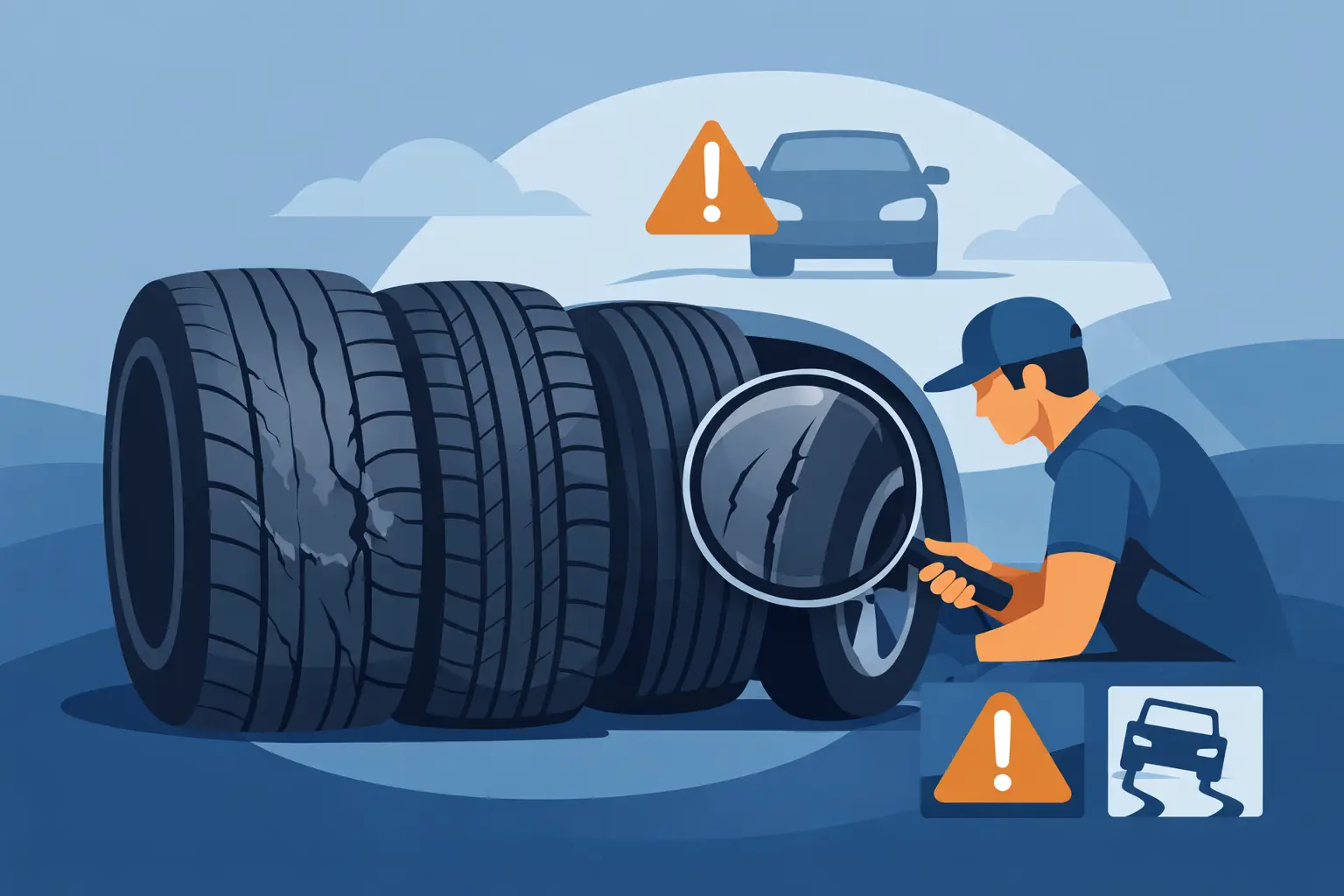
Tread depth matters, but unsafe tires often show damage on the sidewall or in the grooves. Look for cuts, deep scrapes, splits, cracking, and any bulge in the sidewall. A bulge is especially serious because it can mean the internal structure has been damaged, often after hitting a pothole or curb. That tire should not be driven on at normal road speeds.
Small surface marks are not always a reason for replacement. Tires pick up cosmetic scuffs from parking and rough roads. The concern is damage that is deep, expanding, exposing cords, or changing the shape of the sidewall. If you can see fabric, metal, or a lump that was not there before, stop treating it as a cosmetic issue.
Also inspect for objects lodged in the tread. A screw or nail does not always cause an immediate flat, but it can lead to a slow leak. Do not pull it out yourself unless you are prepared for the tire to deflate. Keep the tire inflated if possible and arrange a proper puncture assessment. Whether it can be safely repaired depends on where the damage is, how large it is, and whether the tire has been driven flat.
Watch for Changes While Driving
Your vehicle often gives you an early warning before a visual check confirms the problem. A new vibration through the steering wheel, a thumping sound that rises with speed, pulling to one side, or a sudden need to top up air are all reasons to inspect the tires promptly.
Do not assume every vibration is a balancing issue. It could be a damaged tire, a bent wheel, loose components, or uneven tread. Equally, a car that drifts can be affected by road camber, but if it consistently pulls on a level road, it needs checking.
A tire pressure warning light deserves attention even if the vehicle still feels normal. Temperature changes can alter pressure, so a warning does not automatically mean a puncture. Still, check each tire with a gauge and look for visible damage. Repeated pressure loss means there is likely a leak that needs finding.
When a Tire Needs Urgent Attention
Some issues can wait for a planned appointment, while others should change your plans immediately. Do not continue a normal journey on a tire with a sidewall bulge, exposed cords, a deep cut, severe cracking, or tread worn down to the wear bars. The same applies if the tire is flat or has been driven while flat, as internal damage may not be visible from the outside.
If the car has started shaking badly, pulling sharply, or making a loud repeated thump, slow down safely and stop as soon as you can. Avoid high speeds and hard braking. A spare may get you moving again if it is serviceable and correctly inflated, but it is usually a temporary solution, not a reason to ignore the cause.
For busy drivers, getting to a tire shop is often the difficult part. Lee’s Mobile Tyres can inspect and replace unsafe tires at home, at work, or roadside, saving you from driving on a tire you do not trust.
Make Tire Checks Part of Your Routine
Check your tires once a month and before a longer trip. It takes less time than waiting for a fuel tank to fill. Check pressure, look over the tread and sidewalls, and pay attention to anything that has changed since the last drive.
It also helps to check after a hard pothole impact, a curb strike, or a warning light. Those are the moments when damage and alignment issues can begin, even if the vehicle seems to drive normally afterward.
A tire rarely becomes unsafe without leaving clues. A closer look today can keep a small wear problem from becoming the reason you are stranded tomorrow.