Puncture Repair Rules Guide for Safer Driving
A screw in the tread can look like a quick fix. Sometimes it is. Other times, driving even a short distance on a damaged tire can turn a repairable puncture into a tire that needs replacing. This puncture repair rules guide explains what a technician checks, why the location and type of damage matter, and what to do when you are stuck at home, work, or roadside.
The goal is not to sell you a tire you do not need. It is to get you safely moving again without taking chances with the only part of your vehicle that touches the road.
Puncture repair rules: what makes a repair possible?
A puncture is usually repairable when the damage is small, contained in the central tread area, and the tire has not been driven flat. The central tread is the strongest working area of the tire, designed to handle normal contact with the road. A nail or screw that has gone straight through this section may be suitable for a proper internal repair.
The key word is proper. A repair is not just about stopping the air leak from the outside. A technician needs to remove the tire from the wheel, inspect the inside, find any hidden damage, and use an approved repair method that seals both the injury channel and the inner liner.
A plug pushed in from the outside may seem to hold air, but it does not show whether the tire has been damaged inside. For a dependable result, the tire needs to be checked properly before anyone says it is safe to use.
The location of the puncture matters
Not every hole in a tire is in a repairable area. Damage in the center of the tread is generally the best-case scenario. Once a puncture moves toward the shoulder or sidewall, the answer often changes.
The shoulder is where the tread curves down toward the sidewall. This area flexes heavily as you drive, brake, and corner. A repair there may not hold safely because the tire is constantly bending under load. Sidewall damage is more serious still. The sidewall supports the vehicle and absorbs impacts, so a cut, puncture, bulge, or split usually means replacement is the safer option.
This is why a tire with a screw near the edge should not be judged by appearance alone. It may hold air long enough to get your attention, but that does not make it suitable for repair.
Damage size and shape count too
Small, round punctures from a nail or screw are often the most straightforward to assess. Larger holes, long cuts, tears, or irregular damage are a different matter. So is a puncture caused by a sharp object entering at an angle, which can create more internal damage than is visible from the outside.
A technician will also look for multiple punctures. If several repairs are close together, the structure of the tire may be weakened. There are limits on how many repairs a tire can safely take, and the exact decision depends on the tire’s condition, repair positions, and the manufacturer’s guidance.
Never ignore a tire that has been driven flat
This is one of the most important puncture repair rules. If you have driven while the tire was severely underinflated or completely flat, the sidewalls may have been crushed and overheated. The damage can happen inside the tire, where you cannot see it.
You may reinflate it and find that it holds pressure. That does not prove it is safe. Internal rubber can be scuffed away, cords can be weakened, and the tire can fail later under heat and speed. This is why a professional inspection matters after a flat, even if the visible puncture looks minor.
If you notice a sudden loss of pressure, pull over safely as soon as you can. Avoid sharp steering, hard braking, and continuing to drive to your destination unless there is no safe place to stop. The sooner the weight comes off the damaged tire, the better the chance of avoiding further harm.
Run-flat tires still need inspection
Run-flat tires are designed to travel a limited distance after a loss of air pressure, but they are not automatically repairable afterward. They have reinforced sidewalls and can sometimes get you out of a dangerous location, but driving on them while deflated can still cause internal damage.
The distance and speed limits set by the tire manufacturer matter. So does the vehicle’s tire-pressure monitoring warning, how long the tire was driven, and the type of puncture. Some run-flat tires may be repaired if they meet the relevant requirements, while others should be replaced. Do not assume that because the car remained drivable, the tire is fine.
Tread depth and general condition can make replacement smarter
A tire may have a repairable puncture but still not be worth repairing. If the tread is close to the legal minimum in your area, unevenly worn, cracked with age, or already damaged, replacing it may be better value than paying for a repair that only buys a short amount of time.
Look for signs such as worn-down tread bars, bald patches, deep cracking, exposed cords, or a bulge in the sidewall. Uneven wear can also point to another issue, such as incorrect tire pressure, wheel alignment, or worn suspension components. Fixing the puncture without addressing the cause may leave you with another tire problem soon after.
For vehicles with tires on the same axle that are worn very differently, matching the replacement carefully matters. Different tread depths and tire types can affect grip and handling, especially in wet conditions. A technician can advise whether one tire, a matched pair, or a different solution makes the most sense for your vehicle and budget.
What a safe tire repair should involve
A sound repair starts with finding the exact source of the air loss. It is not always a nail. Air can escape through the valve, wheel rim, bead seal, or a crack in the wheel. Once the cause is confirmed, the tire should be removed and inspected inside and out.
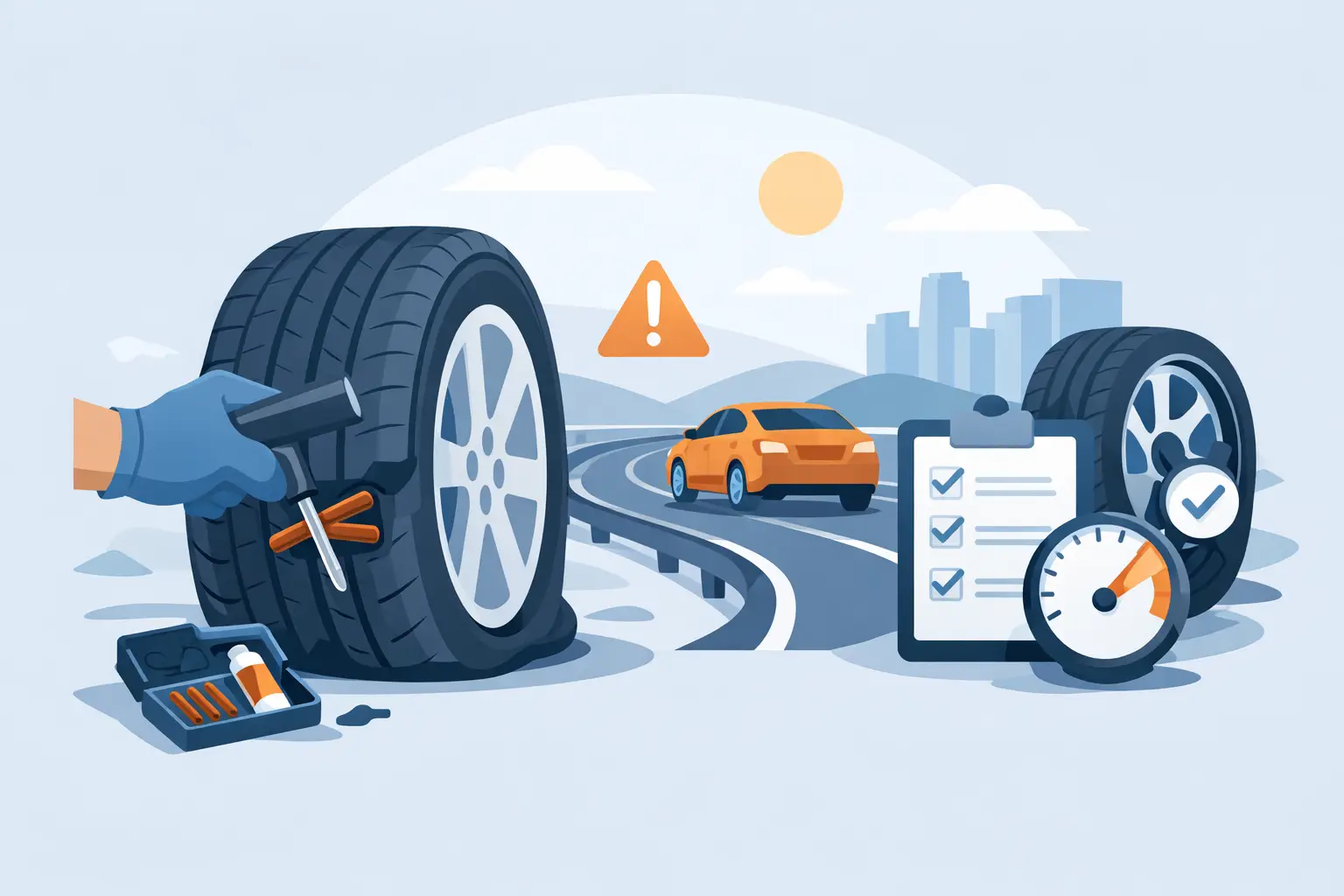
A proper repair normally involves cleaning and preparing the injury, sealing the puncture path, and applying an internal patch or combination repair unit to the inner liner. The tire is then refitted, inflated to the correct pressure, checked for leaks, and balanced if needed. This process takes more care than an outside-only plug, but it gives you a clear answer on whether the tire is genuinely safe to return to service.
What to do when you find a nail or screw
If the tire is still holding air, leave the object in place. Pulling it out can cause a slow leak to become a rapid deflation. Check the pressure, avoid high speeds and long journeys, and arrange an inspection as soon as practical.
If the tire is flat, do not keep trying to drive on it. Fit your spare only if you can do so safely and know it is roadworthy. A space-saver spare has its own speed and distance limits, so treat it as a temporary way to reach help, not a normal tire.
For drivers around Reading, Basingstoke, Bracknell, and nearby areas, Lee’s Mobile Tyres can assess the tire where you are. That means no waiting around at a garage with a flat tire and no unnecessary drive on a damaged wheel. If a safe repair is possible, it can be handled on site. If it is not, you can get practical advice on the replacement options available.
A repair decision should be based on safety, not convenience
It is frustrating to hear that a tire cannot be repaired when the hole looks small. But the visible damage is only one part of the picture. The puncture position, internal condition, tread depth, and whether the tire was driven flat all affect the decision.
When in doubt, protect the tire by stopping early and having it inspected. A fast, honest assessment can save you from a roadside breakdown later and help you get back to your day with confidence.