How to Fix Flat Tyre Roadside Safely
A flat tire never shows up at a convenient time. It happens before school drop-off, on the way to work, in a dark parking lot, or on the shoulder when traffic is flying past. If you’re searching for how to fix flat tyre roadside, the first thing to know is simple: safety comes before speed.
Sometimes a roadside tire change is straightforward. Sometimes it is the wrong call and you are better off staying put and getting help sent out. Knowing the difference can save you time, damage to the wheel, and a lot of stress.
How to fix flat tyre roadside without making it worse
Start by pulling over as far from moving traffic as possible. A flat tire can make the car feel unstable, so avoid hard braking or sharp steering. If you can, ease into a parking lot, wide shoulder, or side street rather than stopping on a narrow bend or near a blind corner.
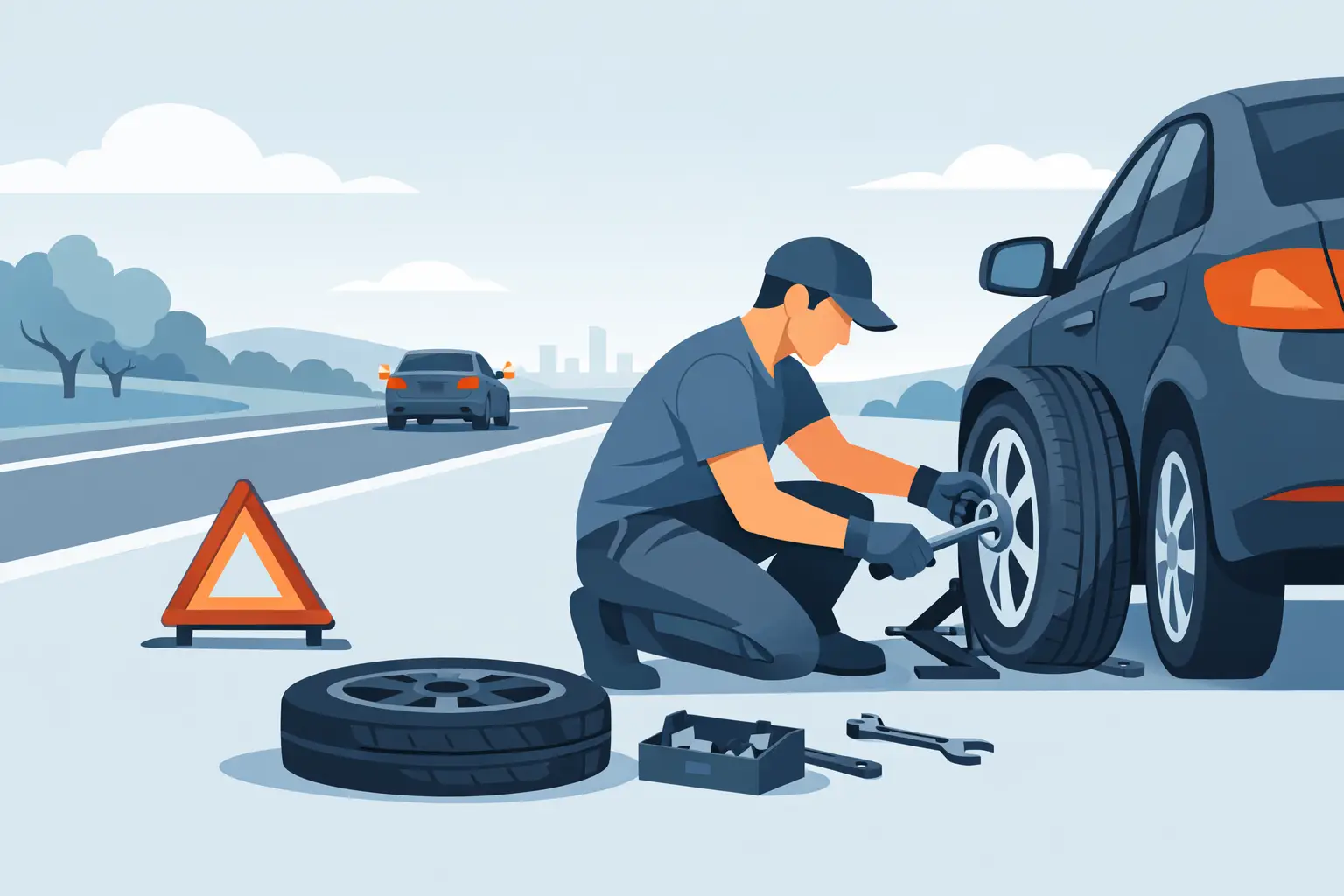
Turn on your hazard lights right away. Put the car in park, set the parking brake, and switch off the engine. If you carry a reflective triangle or road flare, place it where other drivers can see it with enough distance to react. If you have passengers, especially kids, keep them away from traffic and only have them exit the car if it is clearly safer outside than inside.
Before touching the wheel, check what kind of problem you actually have. A simple puncture in the tread area is different from a tire that has split sidewall damage, shredded rubber, or a bent rim. If the tire is badly damaged, completely off the bead, or the wheel itself is damaged, a quick roadside fix usually will not hold.
What you need before you start
Most drivers can only change a flat if the right tools are in the vehicle. Check your trunk or cargo area for the spare tire, jack, and lug wrench. Some newer cars do not come with a full spare at all. They may have a space-saver spare, a tire repair kit, or just a compressor and sealant.
That difference matters. A compact spare gets you moving, but only for a limited distance and speed. Sealant may work for a small puncture in the tread, but it is not a cure-all. It usually will not help with sidewall cuts, blowouts, or larger holes.
If you are missing tools, the ground is soft or sloped, or traffic is too close for comfort, that is your sign to stop and call for mobile tire help instead of forcing it.
Step 1: Loosen the lug nuts before lifting the car
Take the lug wrench and loosen each lug nut slightly while the wheel is still on the ground. Do not remove them yet. This is much easier before the tire is raised, because the wheel will not spin while you apply force.
If the nuts are very tight, use steady pressure rather than stamping on the wrench. Sudden force can slip and cause injury. If a locking wheel nut is fitted, make sure you have the key. Without it, you are not getting that wheel off roadside.
Step 2: Jack up the car at the correct lifting point
Check the owner’s manual for the proper jack point. This is one of the most common places people go wrong. If the jack is placed under the wrong section, you can damage the car or create an unstable lift.
Set the jack on firm, level ground. Raise the vehicle just enough for the flat tire to clear the ground. If the shoulder is sloped, muddy, or crumbling, do not keep going. A shifting jack is dangerous.
Step 3: Remove the wheel and fit the spare
Now fully remove the loosened lug nuts and take the flat tire off. Put the nuts somewhere safe so they do not roll away. Lift the spare onto the hub, line up the holes, and hand-thread the lug nuts back on.
Tighten them lightly in a crisscross pattern. That helps seat the wheel evenly. Then lower the car until the spare touches the ground enough to stop spinning, and tighten the nuts more firmly in the same pattern. Once the car is fully lowered, give them a final tighten.
Do not rely on guesswork forever. Lug nuts should be torqued correctly as soon as possible. Roadside tightening gets you going, but proper follow-up matters.
If you have a repair kit instead of a spare
A lot of drivers open the trunk and find there is no spare at all. In that case, your car may have a sealant kit and air compressor. These kits are meant for limited situations.
If the puncture is small and in the tread area, sealant may temporarily plug the hole long enough to let you drive to a safer place or get to a proper repair. Follow the kit instructions exactly. Usually that means attaching the sealant bottle, inflating the tire, and then driving a short distance so the product spreads inside the tire.
There is a trade-off here. Sealant is quick, but it is temporary and messy. Some punctures can still be repaired afterward, some cannot, and not every tire technician loves cleaning out old sealant. If the hole is too large or the tire has sidewall damage, the kit is unlikely to help.
When not to attempt a roadside tire change
This is the part many people skip. Just because changing a flat is possible does not mean it is safe where you are.
Do not try to fix the tire yourself if you are on a narrow shoulder with fast traffic, on a hill, in poor visibility, during heavy rain, or in a place where the car cannot sit level. The same applies if you do not have the right tools, cannot loosen the lug nuts, or physically do not feel safe doing the work.
There is also the condition of the tire itself. If you drove on it while flat, the sidewall may be ruined even if the original puncture was small. A tire that has been run flat can fail again quickly. In those cases, replacing it is often the safer answer than trying to patch it and hope for the best.
After the spare is on, drive like it is temporary – because it is
A spare tire is there to get you out of trouble, not to carry on as normal for the next two weeks. Most temporary spares have clear speed and distance limits. If you ignore them, you risk uneven handling, poor braking, and damage to the car.
Drive gently, avoid hard cornering, and get the damaged tire inspected as soon as possible. If the puncture is repairable, that may be the most affordable route. If it is not, you will need a replacement tire that matches the vehicle properly.
This is where mobile help makes life easier. If the spare is flat too, the lug nuts are seized, or the tire is beyond repair, having someone come to you is often quicker than arranging a tow and sitting around for hours. For drivers around Reading, Basingstoke, and Bracknell, that is usually the point of calling a local mobile tire service like Lee’s Mobile Tyres – get the problem handled where the car already is and get on with your day.
A few mistakes that cost people time
The biggest one is driving too far on a flat tire. What could have been a simple puncture repair turns into a ruined tire and sometimes wheel damage. Another is using sealant for damage it was never meant to fix. A sidewall cut is not a sealant job.
People also forget to check the spare. It is surprisingly common to fit the spare only to find it has low pressure. If you have not looked at yours in months, or years, now is a good time. Roadside is the worst moment to learn your backup plan is not ready.
The practical answer is the safe answer
If you are in a safe spot, have the right tools, and the damage is limited, changing the tire yourself can be a sensible short-term fix. If any part of the situation feels risky, rushed, or beyond what your vehicle kit can handle, the better move is to stop and get help sent out.
A flat tire is stressful enough without turning it into a bigger problem. Get yourself somewhere safe first, make the call that fits the situation, and focus on getting back on the road without taking chances.