What to Do After a Tyre Blowout on the Road
A tire blowout does not always give you much warning. One second the vehicle feels normal; the next, there may be a loud bang, vibration through the steering wheel, and a strong pull to one side. Knowing what to do after tyre blowout can make a frightening moment far more manageable.
Your first job is not to assess the tire or reach for your phone. It is to keep control of the vehicle, get clear of traffic, and avoid turning a tire failure into a collision. Once you are safely stopped, you can decide whether a spare is a sensible option or whether mobile tire help is the safer, quicker answer.
What to Do After a Tyre Blowout: Control the Vehicle First
A blowout is different from a slow puncture. The tire can lose pressure almost instantly, which changes how the vehicle handles. You may feel the steering become heavy, the vehicle pull left or right, or the rear of the vehicle feel unsettled. Stay calm, keep both hands firmly on the wheel, and look well ahead rather than down at the dash.
Avoid the instinct to hit the brakes hard. Sudden braking can make the vehicle harder to control, especially at highway speed or if a rear tire has failed. Instead, ease off the accelerator and allow the vehicle to slow gradually. Keep the steering as straight as possible and make only small corrections if the vehicle starts to drift.
When you have reduced speed, signal and move carefully toward the right shoulder or the nearest safe place away from moving traffic. If you are on a busy road, a wide shoulder, parking lot, side street, or service area is far safer than stopping where passing vehicles have little room.
Use this order of priorities:
- Hold the steering wheel firmly and keep the vehicle pointed straight.
- Ease off the gas rather than braking sharply.
- Let the vehicle slow down in a controlled way.
- Signal and steer gradually to a safe stopping place.
- Turn on your hazard lights once you are slowing or safely stopped.
If you are towing a trailer, carrying a heavy load, or driving a larger vehicle, give yourself even more distance to slow down. The pull from a failed tire can be stronger, and abrupt movements are less forgiving.
Get Yourself Out of Danger Before Checking the Tire
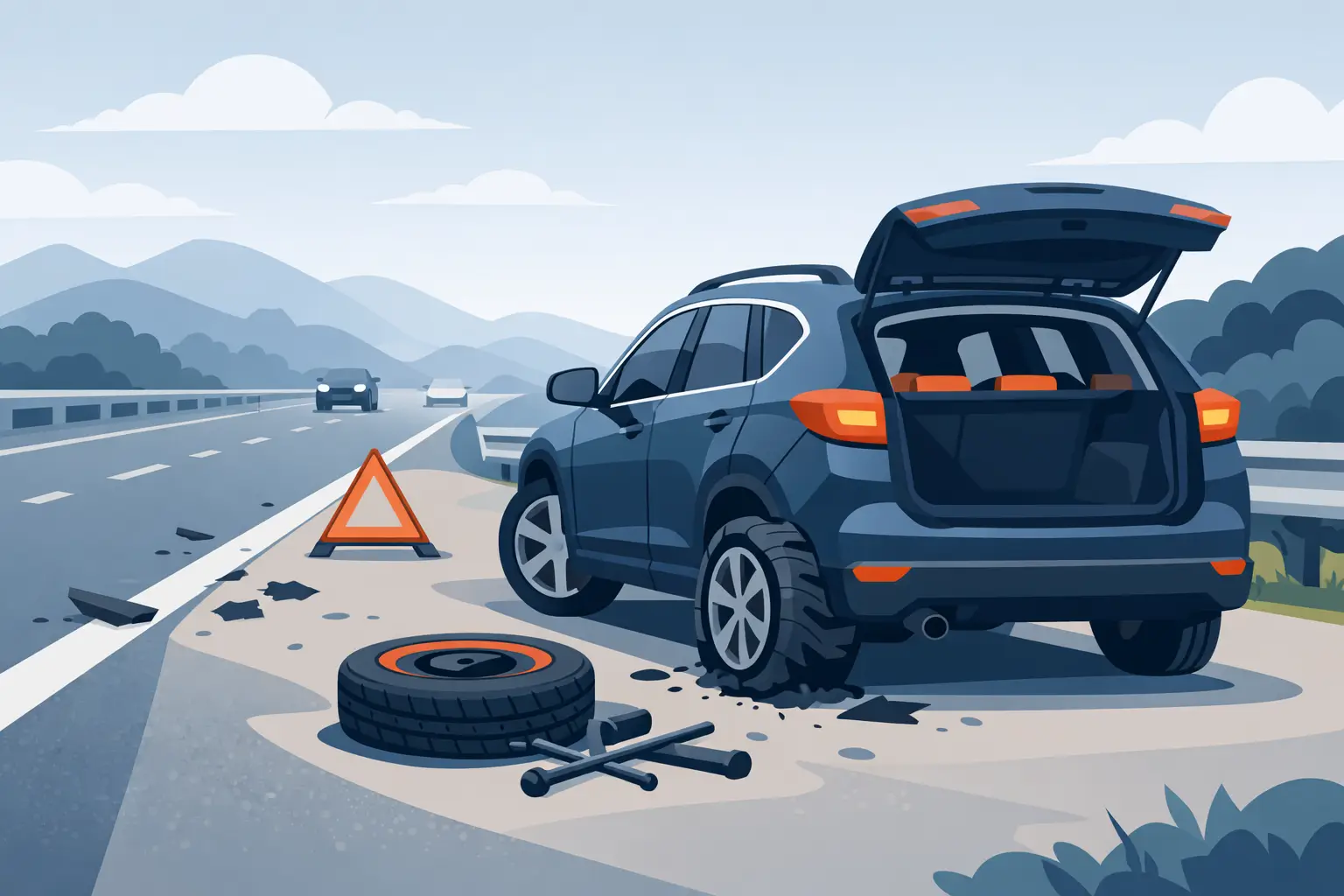
Once stopped, put the vehicle in park, apply the parking brake, and keep the hazard lights on. Take a moment to check where you are. A blown tire is inconvenient, but standing close to fast-moving traffic is the bigger immediate danger.
If you are on a highway shoulder with traffic passing close by, it may be safer to stay inside the vehicle with seat belts on and doors locked while you arrange assistance. Get out only if there is a clear, protected area away from traffic. Never stand on the traffic-facing side of the car to inspect a tire.
If you have stopped in a safe lot, driveway, workplace parking area, or quiet side street, you can inspect the damage from a safe position. Look for a flat sidewall, shredded rubber, a damaged wheel, or pieces of tire around the wheel arch. Do not touch hot or damaged components, and do not assume the wheel is safe simply because it still looks intact.
A severe blowout can damage more than the tire. Loose tread can strike brake lines, wheel-well liners, suspension parts, or bodywork. That is one reason driving even a short distance on a destroyed tire is rarely worth the risk.
Do Not Drive on a Flat or Shredded Tire
It can be tempting to limp to the next gas station, exit, or tire shop. In most cases, do not. A vehicle on a flat tire can quickly destroy the wheel, and the damaged tire can make steering and braking unpredictable. What might have been a replacement tire can become a wheel replacement and a more expensive repair.
There are exceptions where moving a very short distance is safer than staying exposed to danger, such as clearing an active travel lane. If you must move, do so only far enough to reach a safer position, at very low speed, and with the hazards on. Once clear, stop again and arrange help.
Run-flat tires can also cause confusion. Some can be driven for a limited distance after pressure loss, but that depends on the tire model, how badly it was damaged, the vehicle load, and the manufacturer guidance. A true blowout or sidewall failure is not a situation to guess about. Have the tire assessed before continuing.
Decide Whether a Spare Tire Is the Right Fix
A usable spare can get you moving, but only if you can change it safely and it is in good condition. Check whether your vehicle has a full-size spare, a temporary compact spare, or no spare at all. Many newer vehicles are supplied with a sealant kit instead, and sealant will not repair a blown-out sidewall or shredded tire.
Changing a tire on your own makes sense only when you are well away from traffic, on firm and level ground, and confident using the jack and tools supplied with the vehicle. Soft shoulders, uneven pavement, rain, darkness, or passing traffic all make a roadside tire change more hazardous.
Before fitting a spare, check its pressure if you can. A spare that has been sitting under the trunk floor for years may be flat, cracked, or unsuitable for use. If it is a compact spare, follow the speed and distance limits printed on the tire or listed in the vehicle manual. It is a temporary measure, not a return to normal driving.
If the wheel is bent, lug nuts are damaged, the tire is stuck on the hub, or you are unsure whether the spare is safe, stop there. This is exactly when a mobile tire technician can save time and avoid an unnecessary tow.
Arrange the Right Kind of Roadside Tire Help
When calling for assistance, give your exact location first. A nearby landmark, highway direction, exit number, or business name can make the response quicker. Then provide your vehicle make, model, tire size if available, and a clear description of what happened.
You can find the tire size on the sidewall, written in a format such as 225/45R17. If it is not safe to check, do not worry. A technician can often identify the right fitment from the vehicle details. Mention whether you have a spare, whether the wheel appears damaged, and whether the vehicle is in a safe location.
For drivers around Reading, Basingstoke, Bracknell, and nearby areas, Lee’s Mobile Tyres can come to your home, workplace, or roadside location for emergency tire replacement and practical advice. That can be particularly useful when a blowout happens outside normal garage hours or when you cannot safely drive the vehicle anywhere.
The right replacement depends on your budget, vehicle, and the condition of the other tires. A matching new tire is often the best option, particularly on the same axle. In some cases, a fully tested part-worn tire can be a practical, lower-cost solution to get you back on the road. A good technician should explain the options plainly rather than push a choice that does not suit your vehicle or circumstances.
Check the Cause Before You Put It Behind You
A blowout may result from a road hazard, but it can also point to an issue that needs attention. Underinflation creates heat and weakens the tire over time. Overloading, impacts with potholes or curbs, aging rubber, and worn suspension parts can all contribute to sudden tire failure.
After the replacement, ask whether the failed tire shows signs of low-pressure damage, uneven wear, or impact damage. If the tread on your other tires is wearing more on one edge, an alignment check may be needed. If two tires on the same axle are badly worn, replacing only one may affect grip and handling, particularly in wet conditions.
It is also worth checking the remaining tires, including the spare, in the days after the incident. Look for cuts, bulges, cracking, nails, and uneven tread wear. Keeping pressures at the vehicle manufacturer’s recommended level is one of the simplest ways to reduce the chance of another failure.
A blowout is stressful, but you do not need to solve every part of it from the roadside. Get safe first, avoid driving on the damaged tire, and let a qualified professional help you make the next decision with a clear head.